- Date
- 05 NOVEMBER 2026
- Author
- FEDERICO RENOLDI
- Image by
- PRESS OFFICE
- Categories
- Aesthetics
All That Shines: Inside Mariko Mori’s Exhibition at Mori Art Museum
From the futuristic imagination of 1990s Japan to the elemental rhythms of nature, Mariko Mori’s All That Shines exhibition in Tokyo explores the relationship between technology, spirituality, and human consciousness — revealing how the unfamiliar can transform our understanding of the world we inhabit. What if the most extraordinary journey were not the one that takes us beyond our planet, but the one that leads us into the unexplored dimensions of our own consciousness? At Tokyo’s Mori Art Museum, Mariko Mori: All That Shines unfolds as an exploration of the boundaries between the physical and the immaterial. Bringing together approximately forty works spanning more than three decades, the retrospective traces the evolution of an artist whose fascination with technology, spirituality, and the cosmos has continuously reshaped her visual language. Yet what makes this journey particularly compelling is not simply the transformation of Mori’s aesthetics, but the progressive manifestation of an inner search. Her work seems to externalize a consciousness in constant exploration, giving physical form to visions, questions, and possibilities that might otherwise remain invisible. Technology becomes a medium. Imagination becomes architecture. And the unfamiliar becomes a way of reconsidering what we believe we know.
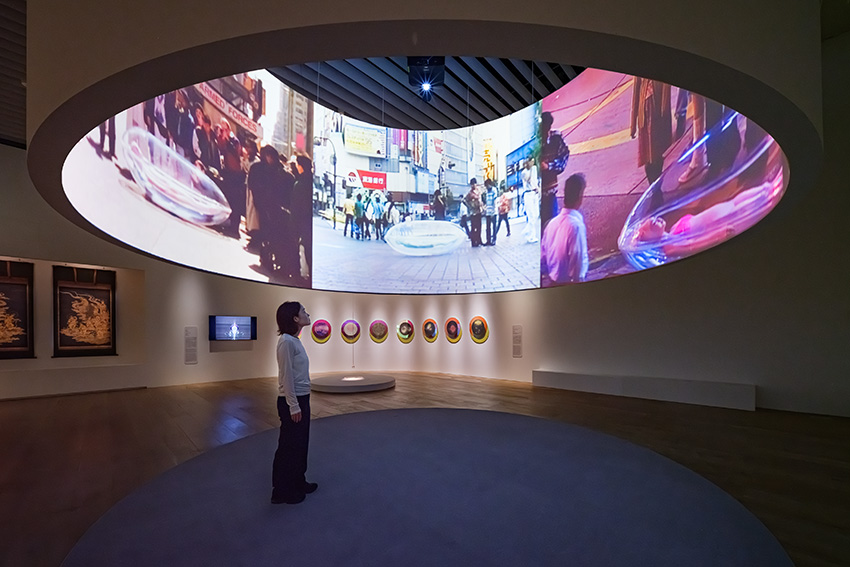
The journey begins in the cultural landscape of 1990s Japan, where video games, anime, science fiction, and emerging digital technologies were reshaping the collective imagination. In her early works, Mori appears as an eccentric, almost otherworldly figure inhabiting ordinary urban environments. Dressed in futuristic costumes, she seems to have stepped out of a video game and into the streets of Tokyo. In Play with Me (1994), her presence is simultaneously playful and dissonant, familiar and alien. She belongs to the visual culture surrounding her while appearing strangely detached from it. This tension between estrangement and belonging becomes a recurring element throughout her artistic practice. Drawing upon the aesthetics of Japanese popular culture, Mori transforms her own body into a vehicle for imagined identities. The virtual becomes a language through which alternative possibilities of existence can be expressed, extending beyond conventional representations of the human. Yet beneath the apparent playfulness lies a deeper investigation into identity and consciousness. Rather than seeing these early experiments as a phase preceding Mori’s spiritual research, they can be understood as some of its first visual manifestations. The questions surrounding existence are already present; what evolves is the language through which they are explored.
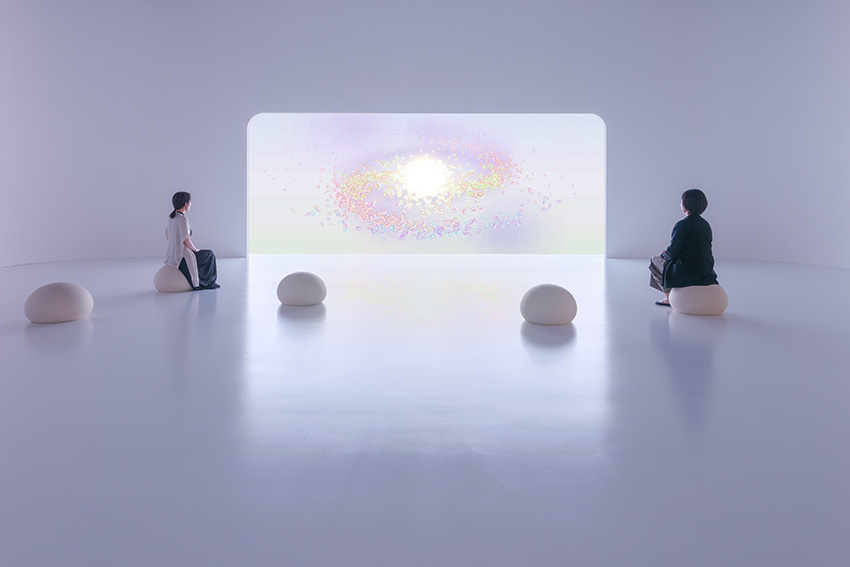
As the exhibition progresses, Mori’s visual universe gradually transforms. The saturated imagery of the metropolis gives way to luminous structures, immersive environments, and increasingly contemplative spaces. Technology remains central, but its function expands.
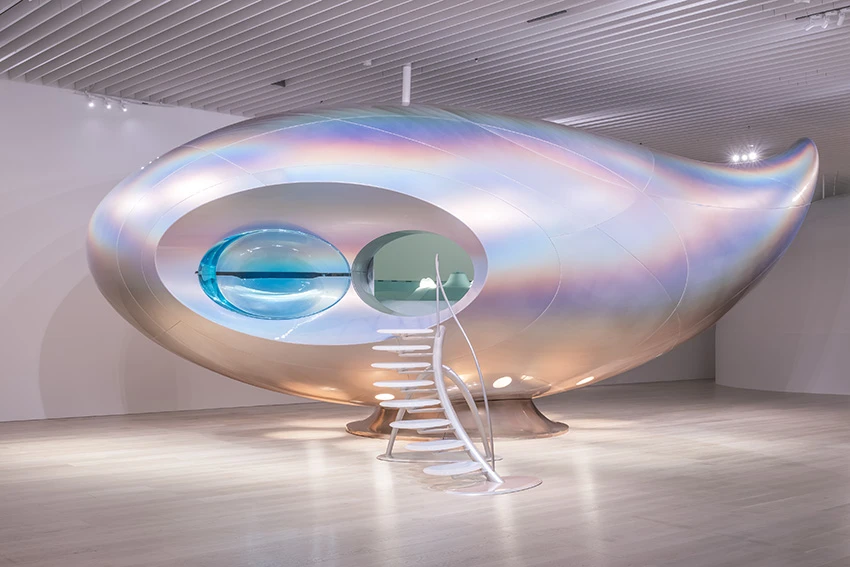
What initially appears as a tool for constructing fictional identities becomes a medium through which the invisible dimensions of consciousness can be externalized. This transformation finds a compelling expression in Wave UFO (1999–2002), an inhabitable structure whose organic, spacecraft-like form suggests a vessel from an unknown civilization. Through brainwave biofeedback and immersive projections, the installation translates neurological activity into visual experience, allowing participants to encounter representations of processes ordinarily concealed within the mind. The spacecraft, traditionally associated with journeys toward distant worlds, acquires another possible meaning: that of a sanctuary of consciousness.
A place that physically exists on Earth while suggesting entry into an entirely different dimension. Here, Mori’s imagined worlds are no longer confined to images. They become environments that can be entered and experienced. Her inner projections acquire material presence, and the spectator is invited to move beyond observation into participation.
The virtual is no longer merely an alternative to reality. It becomes a portal through which the intangible can assume form.Perhaps technology, so often associated with expanding our external world, might also become a vehicle for exploring the unknown territories of the self.
Throughout this evolution, Mori’s artistic language undergoes a gradual distillation. The vibrant artificiality of her early works transforms into a vocabulary of transparency, light, geometry, and organic forms. Yet this refinement does not imply a rejection of her earlier sensibility. The curiosity, experimentation, and playful fascination with unfamiliar worlds remain. What changes is the scale of her investigation. The body, initially transformed through costumes and fictional identities, becomes part of a broader inquiry into the relationship between consciousness, nature, and the universe.
In Nirvana (1997), Mori draws upon Buddhist imagery while employing digital technology to construct an immersive, multisensory experience. Science and spirituality are not presented as opposing forces, but as different languages through which questions of existence can be explored. This dialogue continues in her later production, informed by Buddhist cosmology, ancestral cultures, and astrophysical research. The universe becomes more than a distant physical reality. It emerges as a space through which to reconsider the nature of human existence. And as Mori’s work expands outward toward the cosmos, it simultaneously appears to turn inward. As though exploring the universe and exploring consciousness were two expressions of the same fundamental desire: to understand what lies beyond the limits of immediate perception.
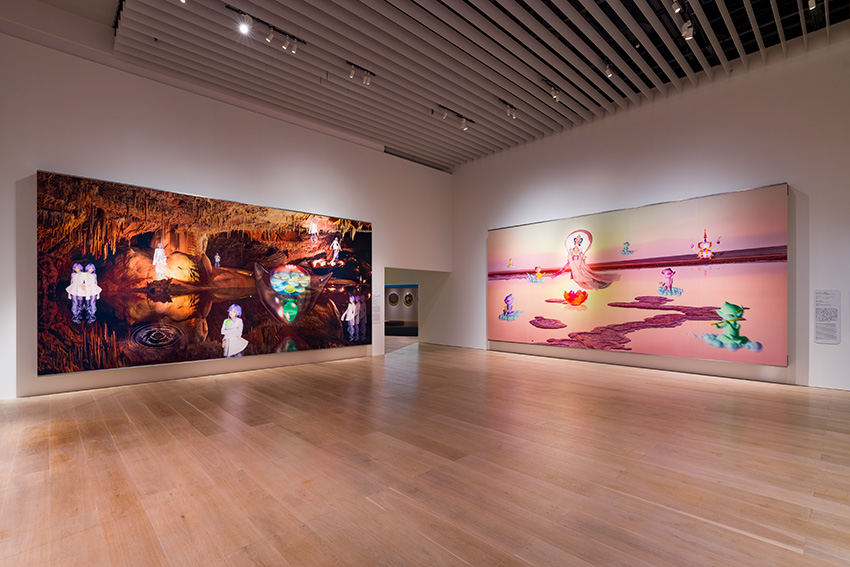
One of the most compelling continuities throughout All That Shines is Mori’s relationship with the unfamiliar. In her early works, she appears almost alien within the Japanese metropolis. Later, she creates inhabitable structures that resemble vessels from distant civilizations, inviting spectators into environments detached from ordinary experience. The relationship between observer and observed gradually shifts. Initially, we encounter Mori as an unfamiliar presence within a recognizable world. Later, we become the visitors entering her unfamiliar worlds. The artist no longer simply represents alternative realities. She constructs spaces through which we can experience them.
This evolution extends beyond the exhibition itself. In her architectural practice, the futuristic and organic forms that once suggested imaginary vessels find a counterpart in structures designed to exist within the natural landscape. Her building Yuputira, on Miyakojima, reflects this continuity between artistic imagination and inhabitable space. Its sculptural white architecture appears almost otherworldly, yet remains intimately connected to its coastal surroundings. What once suggested a journey beyond the familiar becomes a place in which to experience the world differently. Perhaps the unfamiliar does not necessarily belong elsewhere. Its very strangeness may be what allows us to question the boundaries of the familiar.
Mori’s environments can therefore be interpreted as invitations to investigate territories that are not geographically distant, but psychologically and spiritually unexplored: dimensions of memory, imagination, thought, and consciousness that we rarely confront. The journey does not necessarily require physical displacement. It may instead demand a transformation in perception.
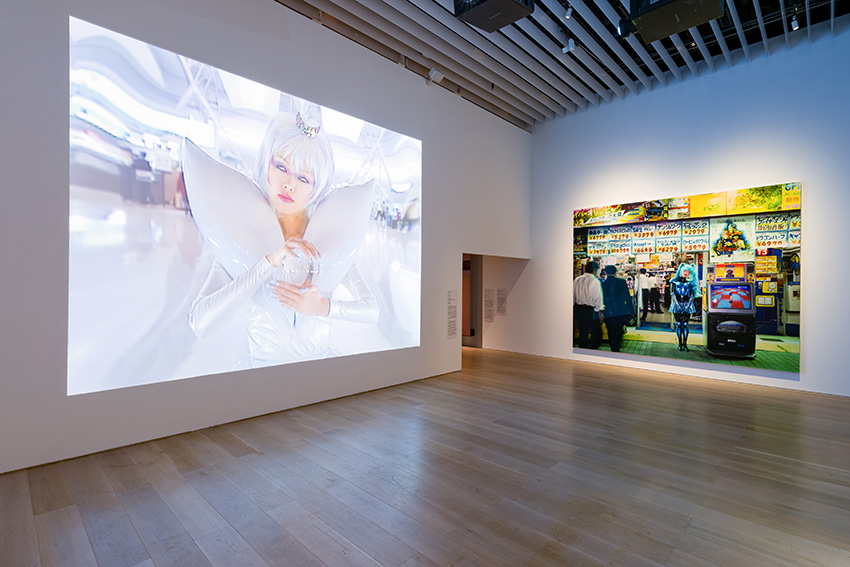
In the later chapters of the exhibition, Mori’s research increasingly engages with ancestral memory, natural phenomena, and the interconnectedness of existence. Works such as Tom Na H-iu (2006), Primal Rhythm: Sun Pillar (2011), and Ring: One with Nature (2016) bring technological experimentation into dialogue with ancient forms of knowledge. The futuristic object begins to resemble a sacred monument. The luminous installation acquires the presence of a ritual space. Technology becomes a means of contemplating forces that extend beyond individual human experience. Rather than presenting progress as a departure from humanity’s ancestral past, Mori suggests the possibility of continuity between them. This relationship resonates with the concept of Oneness, central to her artistic philosophy: an understanding of existence as an interconnected whole extending across humanity, nature, time, and the cosmos. The distinction between artificial and natural becomes increasingly uncertain. In a world that frequently understands technology as a means of separation from the natural environment, Mori explores its potential to reconnect us with the relationships and rhythms that define our existence.
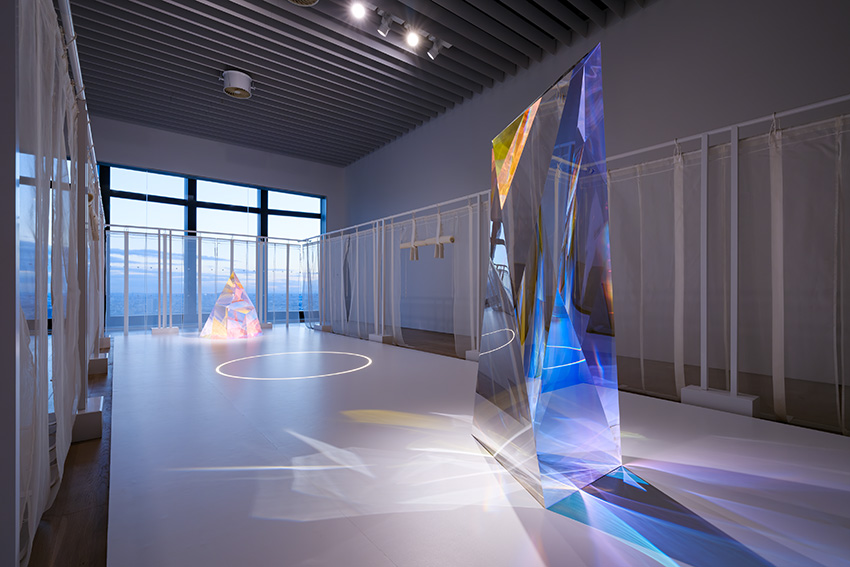
After travelling through virtual identities, futuristic vessels, spiritual architectures, and cosmic dimensions, the exhibition reaches a conclusion that feels almost disarmingly simple. We return to Earth. In the final gallery, a luminous screen opens onto images of the natural world. Among the scenes presented in All That Shines (2026), the ocean and the changing light surrounding Mori’s island studio offer a particularly evocative encounter with the elemental forces of existence. After so much technological exploration, we encounter the most fundamental expressions of the world around us. Water. Air. Earth. Light. Everything exists within a continuous process of transformation, governed by the movement of the sea, the passage of time, and the rhythms of nature. Within this visual journey, the crystalline form encountered against the coastal landscape suggests an unexpected presence, almost alien in its geometry yet intimately connected to the environment surrounding it. It evokes a mysterious monument or a cosmic antenna, silently reaching toward forces beyond the visible world. Exposed to the changing light of the sun, moon, and stars, the crystal suggests persistence and resilience — not necessarily as resistance to change, but as the possibility of existing through it. Its apparent otherness does not imply separation. It exists within the same cycles of light, time, and transformation that shape the natural world. And perhaps this is where the relationship between estrangement and belonging finds its most compelling expression. At the beginning of the exhibition, Mori appears as an alien presence within the metropolis. Later, her futuristic vessels seem to invite us toward unfamiliar dimensions. Finally, an alien-looking crystal appears within an entirely terrestrial landscape. The unfamiliar has never disappeared. It has simply changed form. But now, rather than suggesting separation from the world, its presence invites us to reconsider our relationship with it. After decades of imagining distant futures and alternative realities, Mori returns us to the ocean, the sky, and the elemental forces of nature. Yet we no longer encounter them in quite the same way. The extraordinary no longer appears to exist exclusively beyond our world. It may already be present within it.
Perhaps the most compelling aspect of All That Shines is that it does not offer a definitive destination. Instead, it proposes a journey through different ways of perceiving existence. Mori’s artistic evolution can be understood as the progressive externalization of an inner search, moving through Japanese popular culture, technological experimentation, spiritual traditions, and cosmic imagination. Her works transform questions about consciousness into images, objects, and environments that invite the spectator to undertake a similar exploration.mThe virtual becomes tangible. The imagined becomes inhabitable. And the unfamiliar becomes a means of rediscovering the familiar. The final crystalline presence, encountered between the ocean and the sky, seems to bring these ideas together: a form that appears alien yet exists within the rhythms of nature, suggesting a connection between the terrestrial and the cosmic, the physical and the spiritual. After encountering vessels that evoke exploration, we arrive at an image of stillness. Perhaps this is the exhibition’s most intriguing paradox. The journey does not necessarily culminate in reaching another world. It may culminate in learning to perceive our own differently. In imagining what lies beyond the human body, Mariko Mori ultimately invites us to reconsider what it means to inhabit one — and to recognize our place within a universe to which we have always belonged.
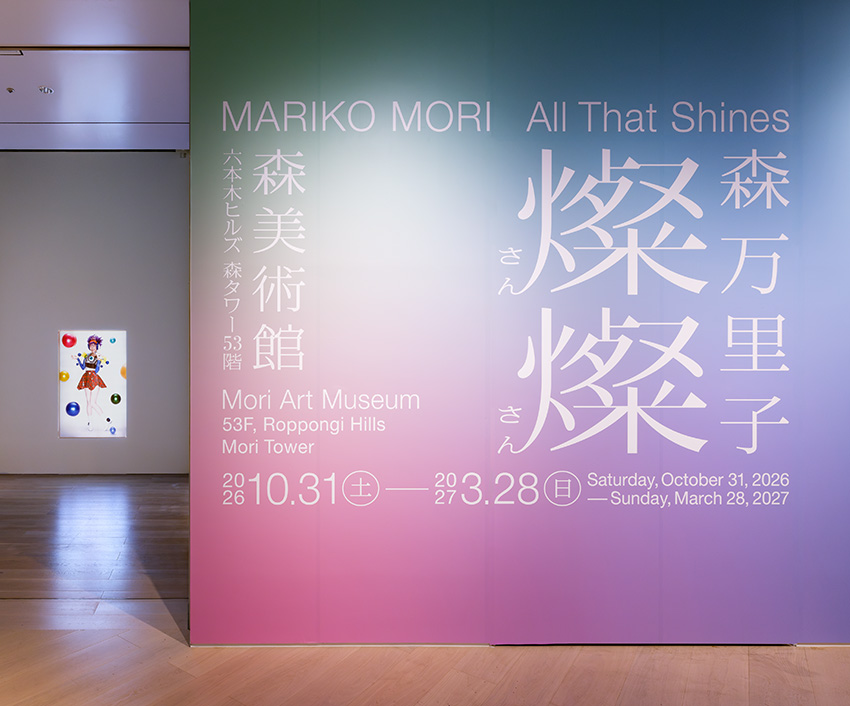
Visit the exhibition:
MARIKO MORI: ALL THAT SHINES
Mori Art Museum, Roppongi Hills Mori Tower, 53F, Tokyo
October 31, 2026 – March 28, 2027