- Date
- 22 APRIL 2026
- Author
- GLORIA MARIA CAPPELLETTI
- Image by
- PRADA PRESS OFFICE
- Categories
- News
In Sight, In Question: Prada Frames 2026
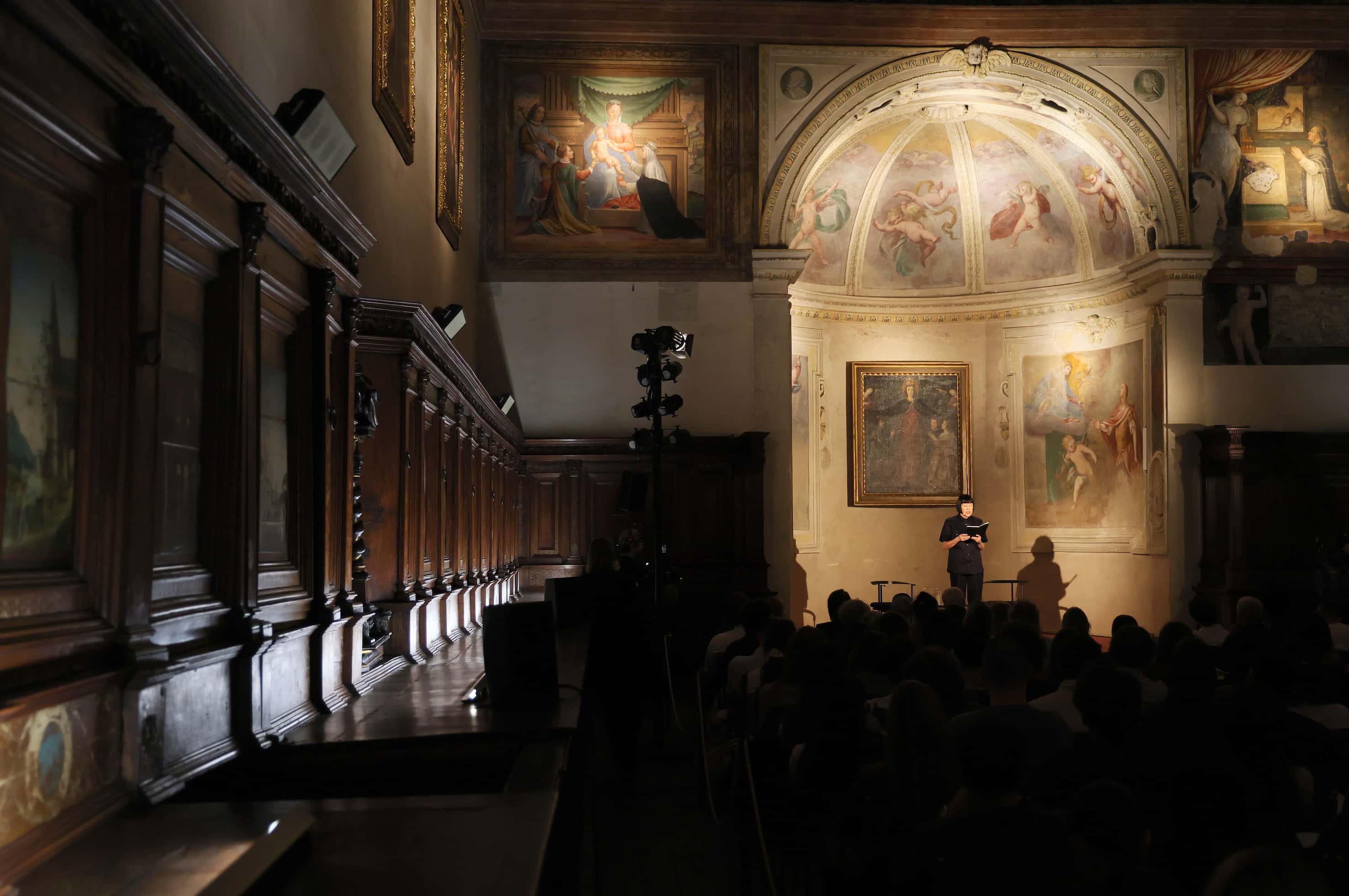
Beneath the Renaissance vaults of the Sacrestia of Santa Maria delle Grazie, traditionally attributed to Donato Bramante and lined with intarsia panels depicting biblical scenes, the space gathers bodies into a suspended field of attention.
Outside the saturated cartography of Milan Design Week, where objects compete for visibility and attention is fragmented into surfaces, products, spectacles, and ephemeral installations; inside Prada Frames persists as a deliberate, questioning anomaly. Now in its fifth iteration, the symposium curated by Formafantasma unfolded as a slow, resonant counterpoint to the acceleration of contemporary visual culture.
Titled In Sight, the 2026 edition turned its gaze toward the image as a cultural and political force, entangled in infrastructures, economies, and systems of power. What follows is an attempt to register what lingered: the residual impressions, the unclosed arguments, the questions that refused to settle.
Prada Frames has always positioned itself at the intersection of design, culture, and society, privileging ideas over products and cultivating a space where disciplines dissolve into dialogue. In In Sight, this methodology reached a particularly lucid articulation. Images were actually discussed as operational entities, agents that mediate perception, construct reality, and increasingly blur the boundary between human and machine authorship.
The Renaissance setting intensified this inquiry. Inside the sacristy, its intarsia wood panels narrating biblical scenes with quiet precision, attributed to Bramante and executed by Domenico and Francesco Morone, the contemporary condition of image production appeared in stark contrast: from crafted representation to algorithmic proliferation, from singular authorship to generative multiplicity. Here, the image revealed its paradox: it has never been more abundant, and never more unstable.
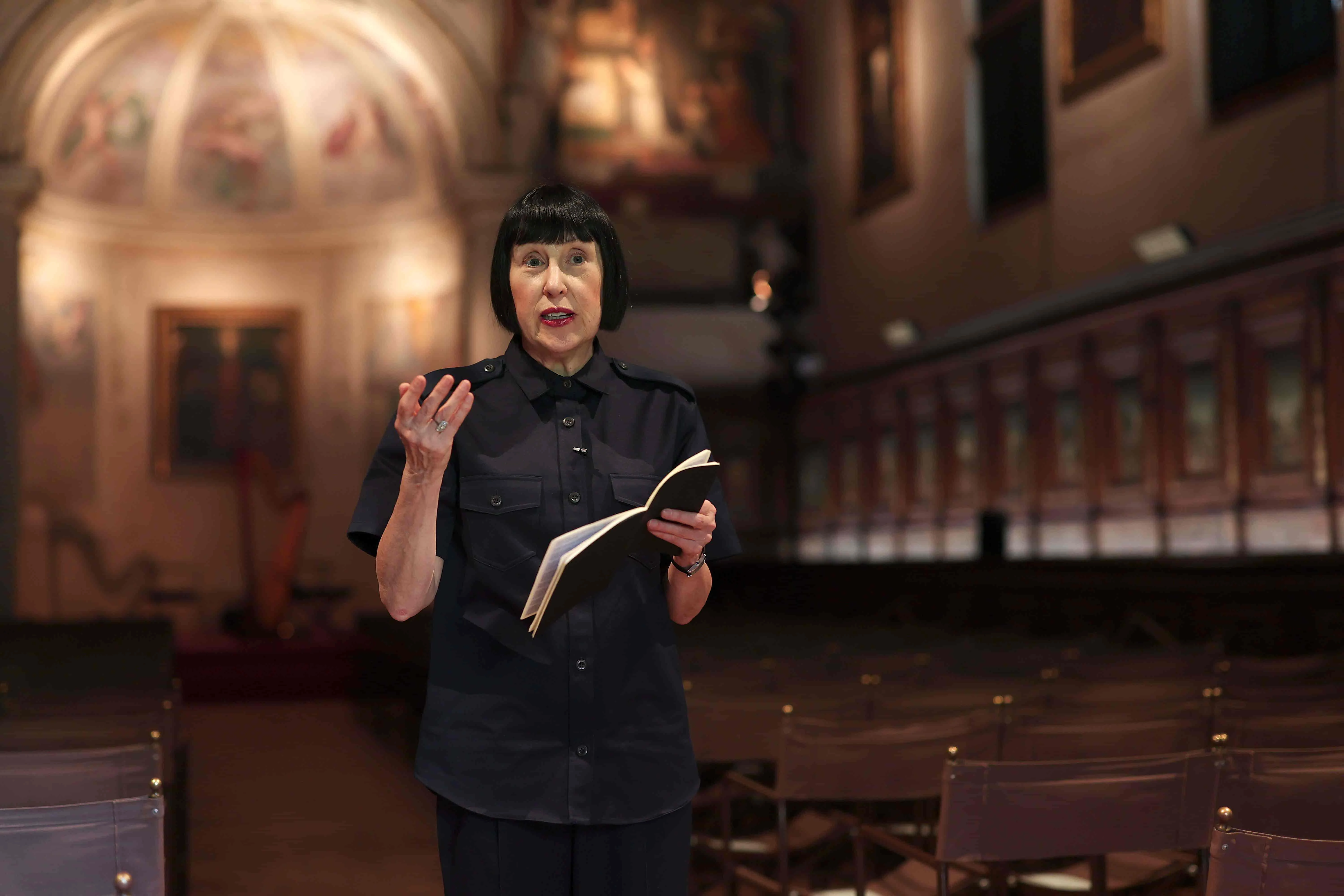
Presiding over this fragile yet fertile terrain was Alice Rawsthorn. Her voice was precise and disarmingly generous, it created continuity across the three days, offering each session a thoughtful frame without constraining it. In a symposium structured around complexity, Rawsthorn's role became essential: she held space for contradiction, allowing tensions to remain unresolved, questions to linger, and speakers to share their experience and research.
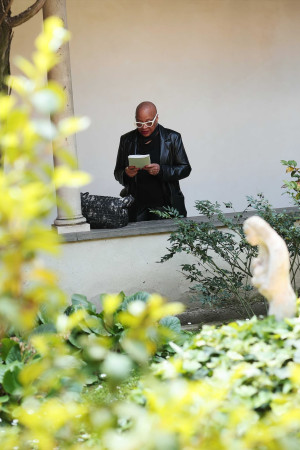
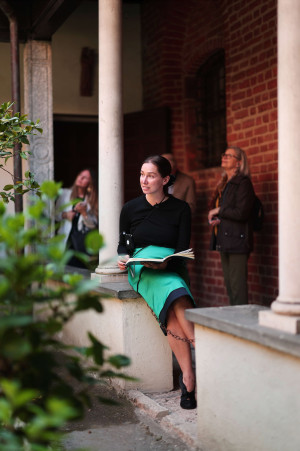
One of the most striking dimensions of In Sight emerged through the performative readings staged within the architectural complex, where language itself became image. Voices moved through space, activating the sacristy as a resonant body. The readings drawn from philosophy, poetry, and theory transformed discourse into experience, shifting perception from the visual to the sensory and affective. In this context images appeared as vibration, memory, dream. To listen to a text read aloud within those sixteenth-century walls was to understand that images are not only seen.
Running parallel to the spoken word, the musical intervention by Neapolitan composer Renato Grieco introduced another layer of perception. Across the three days, his compositions dialogued with the symposium. If images today are increasingly produced through machines, Grieco's music suggested another possibility: that images can also emerge through listening. Sound became a generative field an immaterial architecture capable of producing images within the interiority of the listener. In a symposium devoted to interrogating visual culture, this sonic dimension offered a subtle but radical counterpoint, because it reminded us that perception exceeds vision. The eye is not the only organ of encounter.
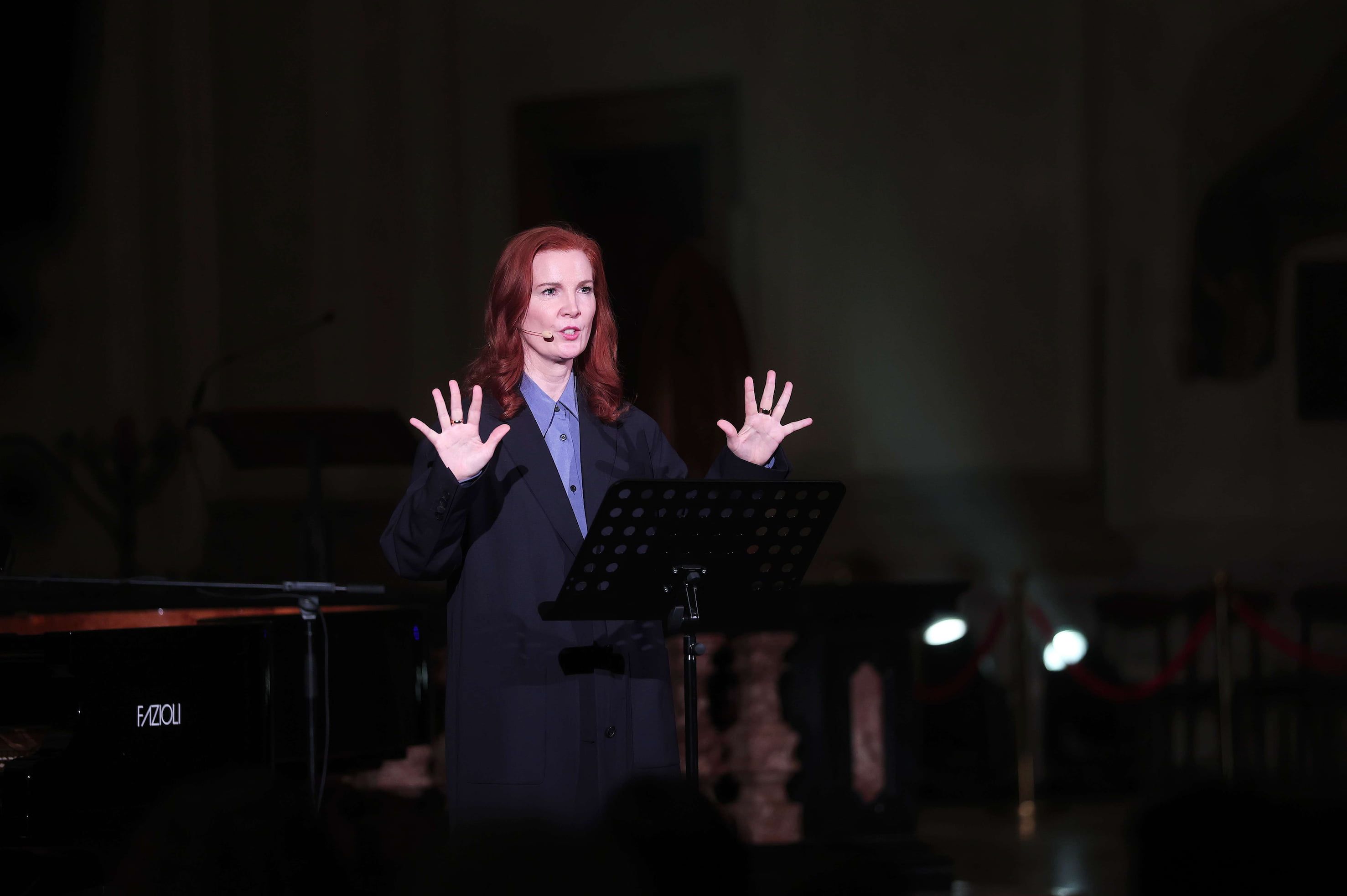
Among the constellation of voices, several interventions crystallized the urgency of the symposium's inquiry. Kate Crawford articulated the material and political substrate of AI-generated images, revealing the extractive infrastructures, resources, labor and energy that underpin their apparent immateriality. The image, in her framing, becomes inseparable from planetary systems of production. To look at a generated image is to look through it, toward the server farms, the cooling systems, the underpaid data laborers, the geological extraction. There is no such thing as an immaterial image. There is obscured materiality that needs to be strongly addressed.
Geert Lovink sharpened the critique further, exposing platforms as environments of structural violence, where attention is captured, exhausted, and redirected within opaque architectures. His diagnosis was unsparing as we are used by platforms and we inhabit them. And to inhabit them is to submit to a visual economy designed to avoid clarity, an emotional economy designed for retention. The image, in this economy, is not a vehicle of meaning but a hook. Its aesthetic qualities are secondary to its capacity to interrupt the scroll.
And then there was Mark Leckey. Moving between the liminal spaces of the late Middle Ages and the Renaissance, Leckey delivered an inspiring semiotic reading of Paolo Uccello's The Battle of San Romano, a painting of chaotic combat, lances crossing, horses rearing, figures entangled in a field of visual noise. His provocation was simple and unexpected: those times, he suggested, resemble our times. The fifteenth century, with its collapsing certainties and its technological upheavals such as the linear perspective, was not so different from the present. Leckey's reading transformed the sacristy into a time machine.
Across these perspectives, a shared condition emerged, that the image is no longer an object we observe. It is possibly a system we inhabit.
A recurring thread throughout the symposium was the proliferation of what has been termed "AI slop", which is a flood of low-quality, endlessly generated images that saturate digital environments. Yet the discussion resisted simplistic dismissal. The question was not only aesthetic, but semiotic: what happens when the production of images exceeds the capacity to interpret them?
In such conditions, meaning itself becomes unstable. Images no longer clarify reality, on the opposite they obscure, multiply, and fragment it. The risk is not merely misinformation, but a deeper transformation, a shift from a culture of interpretation to a culture of continuous exposure, where the act of seeing no longer guarantees understanding. We are all, it seems, perpetually in sight visible and categorized, but rarely in insight. The symposium's title revealed itself in this paradox.
The speakers did not propose a technical solution to this condition. There is no algorithm to restore trust, no watermark to guarantee authenticity. Instead, the response was pedagogical and critical because to see an image today is to ask not only "what does it show?" but "who produced it, under what conditions, for what purpose, and at what cost?" It is also an acknowledgment that images, all sort of images, have always been constructed, and that the task of criticism is to make those constructions visible.
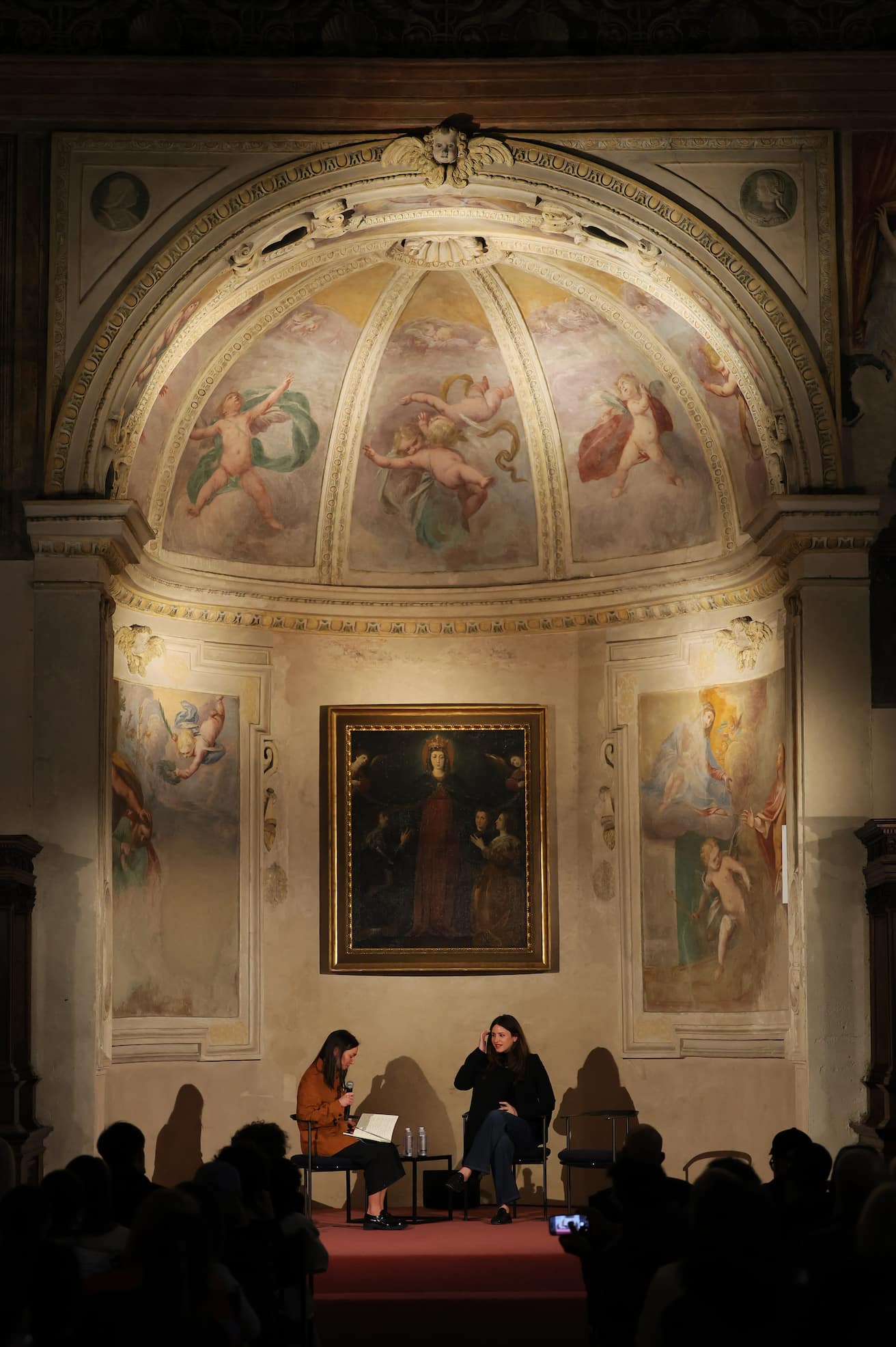
If there is a defining quality of Prada Frames, it lies precisely in its refusal to resolve. The symposium does not aim to produce answers, but to sustain inquiry. It resists the demand for clarity, embracing instead a condition of productive questioning. This ethos is embedded in its very structure: interdisciplinary, dialogic, slow. As the official framing has long suggested, the goal is to make complexity visible, to create a space where contradictions can coexist without being prematurely reconciled.
In this sense, Prada Frames operates as a semiotic device. It reveals how meaning is constructed, negotiated, and destabilized across systems of images, language, and perception. The Renaissance sacristy, with its fixed biblical narratives, becomes a foil for the contemporary condition of floating signifiers. The Morone brothers' intarsia panels depict a world where meaning is anchored by theology, by patronage and by craft. Our world, by contrast, is one of drift or perhaps a different kind of order that requires constant attention, constant questioning, constant acts of reading against the grain.
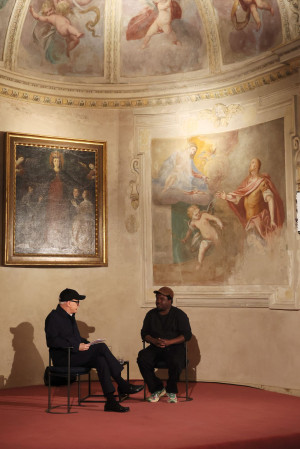
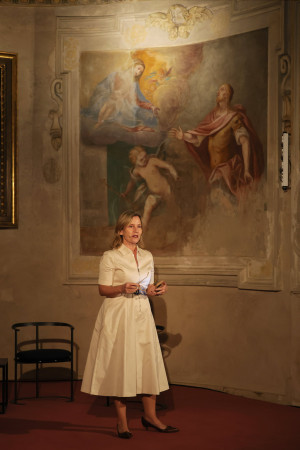
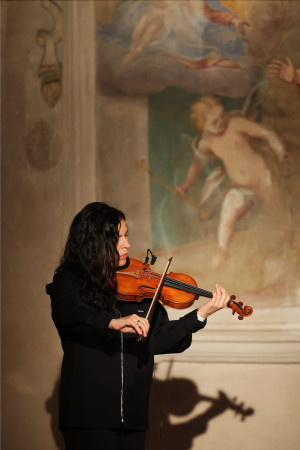
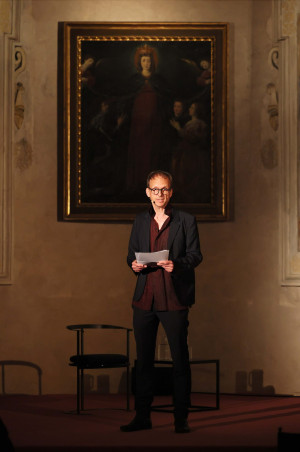
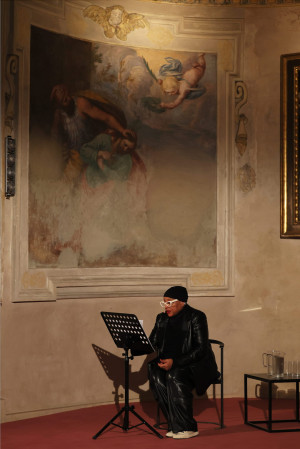
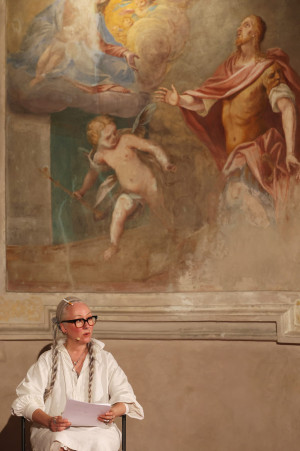
Leaving the Sacrestia of Santa Maria delle Grazie on the final day, one carried residual impressions, fragments of thought, tonalities of voice, echoes of music, the rustle of pages during the readings. Perhaps the most precise outcome of In Sight is a shift in awareness. To look at an image, after Prada Frames 2026, is to perceive its conditions of existence, infrastructures and its politics. It is to understand that every image contains not only what it shows, but what it conceals such as labor, energy, history and overall human intention.
And yet, beyond critique, something else remains. A quieter intuition: that images, despite everything, still retain a capacity to move us, to generate meaning, to open worlds and to resonate within the body, consciously or unconsciously. Between AI slop and signal, between system and sensation, Prada Frames situates itself in that unstable, necessary space where thinking begins again.
As we stepped back into the noise of Milan Design Week with its parties, launches, the endless circulation of faces and products, the contrast was jarring. But perhaps that is the function of a symposium like this. To have seen differently, even for a few days, is to be slightly altered. The images will keep coming. The algorithms will keep optimizing. But somewhere, in the residue of those three days in the Sacrestia, a different relation and attention to the image became possible.
And attention, as Prada Frames reminds us, is the rarest and most political resource of all.
Text by Gloria Maria Cappelletti
Images Courtesy of Prada Press Office
Special Thanks to P:S Agency
Prada Frames "In Sight" took place April 19–21, 2026, at Santa Maria delle Grazie, Milan. The symposium was curated by Formafantasma, contextualized by Alice Rawsthorn, with musical direction by Renato Grieco and performative readings activating the Renaissance complex. Further information: Prada Frames 2026
Speakers: Paola Antonelli, Ed Atkins, Alvaro Barrington, Ila Bêka & Louise Lemoine, Marine Brutti, Barbara Casavecchia, Wendy Hui Kyong Chun, Kate Crawford, Natalia Grabowska, Anouchka Grose, Alfredo Jaar, Mark Leckey, Geert Lovink, Gideon Mendel, Momtaza Mehri, Hans Ulrich Obrist, Jussi Parikka, Joanna Piotrowska, Hania Rani, Alice Rawsthorn, Julian Rosefeldt, Sharon Sliwinski, Barbara Maria Stafford, Jonas Staal, Deborah Willis, Akram Zaatari, Joanna Zylinska.