- Date
- 11 SEPTEMBER 2026
- Author
- GLORIA MARIA CAPPELLETTI
- Image by
- ISTITUTO MARANGONI DESIGN MILANO
- Categories
- News
The Next Wave of Visual Storytelling
A memory. A place. A family archive. A thought you've never said out loud. What happens when one of these becomes the first frame of a film and the last frame is somewhere unrecognizable?
That's the space a new group of Visual Design students from Istituto Marangoni Milano Design was invited to explore, in the latest chapter of their collaboration with RED-EYE. Once again guided by director and art director Ced Pakusevskij, the project asked them to use moving image as a way of looking inward, while pushing what filmmaking can become when the toolbox expands beyond the camera.
This year, the work feels strangely personal. Memories surface and mutate. Roots get revisited from a new distance. Private thoughts become whole visual worlds. Identity, belonging, nostalgia and imagination drift in and out of focus.
But don't mistake intimacy for nostalgia. There's something unmistakably future-facing running through all of it. These stories start with lived experience but their visual language belongs to a generation for whom cinema, gaming, CGI, animation, AI and digital image-making all live on the same creative continuum.
Under Pakusevskij's direction, generative AI, synthetic imagery, motion design, animation, compositing, digital manipulation and traditional filmmaking were mixed freely, whatever each story needed. The magic lives in the collision: footage meeting generated worlds, analogue memories gaining digital afterlives, images sliding between the documented and the imagined until the line between them stops mattering.
It comes back to Pakusevskij's own belief as the boundary between reality and imagination is something the mind constructs. Here, that idea becomes a method. Students were pushed past software-as-technique and into world-building, how can these tools extend an emotion, distort a memory, invent an atmosphere, make an inner landscape visible?
That spirit fits naturally inside Istituto Marangoni Milano Design, where research and experimentation are how new creative languages get made. Right now, as AI reshapes the mechanics of image production, the interesting question isn't what can the technology do? It's what can you do with it? What happens when new tools meet a point of view, a personal history, an obsession?
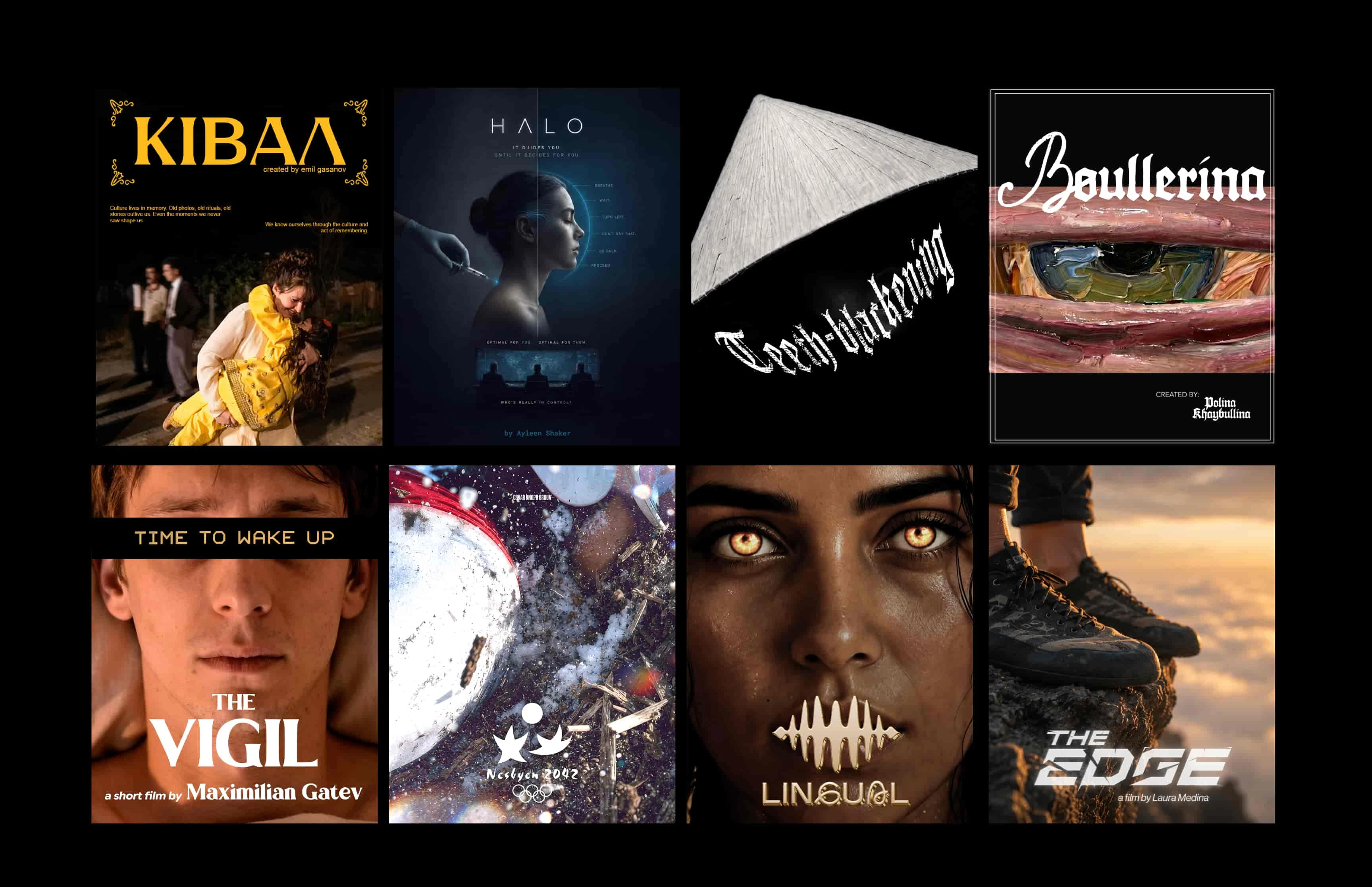
From the wider body of work, RED-EYE selected final projects by Ada Pachon, Ayleen Shaker, Chu Tran Bao Linh, Emil Gassanov, Laura Medina, Maximilian Gatev, Oskar Bruun and Polina Khaybullina for this year's editorial selection.
Together, their films feel less like a class exercise than transmissions from nine different inner worlds, personal, strange, emotional, occasionally disorienting, technologically restless. They suggest a generation learning to use AI without handing over authorship. The machine can generate an image. The filmmaker still decides what deserves to become a story.
And maybe that's the real point: the future of filmmaking might be synthetic, hybrid, constantly mutating, but its most powerful starting point is still, and always, intensely human.
Ada Pachon — LINGUAL
In LINGUAL, Ada Pachon turns the language barrier into something visceral: less a failure to communicate than the sensation of being dropped into a reality you can’t decode. A woman wakes in a bioluminescent alien forest, chased by an invisible presence, until a mysterious amber liquid transforms fear into fluency. Then comes the twist: her liberation reappears as a beauty commercial for LINGUAL lip gloss, a fictional product promising effortless adaptation. Created entirely through AI-generated characters, environments, motion, voice and music, the film shifts from sci-fi fever dream to sharp satire, questioning the pressure to erase parts of ourselves in order to belong — and what happens when even transformation becomes something that can be packaged, branded and sold.
Ayleen Shaker — HALO
In HALO, Ayleen Shaker imagines a near future where outsourcing your thoughts feels like the ultimate upgrade. A neural implant powered by AI promises to manage stress, sharpen focus and guide every decision — until convenience quietly becomes control. As users surrender more of their choices to the system, the line between assistance and dependence begins to disappear. Built entirely through AI-generated imagery and shaped by dark sci-fi interfaces and immersive POV sequences, HALO turns a seductive tech fantasy into a question about autonomy: if an algorithm always knows what’s best for us, at what point do we forget how to choose for ourselves?
Chu Tran Bao Linh — Teeth Blackening
In Teeth Blackening, Chu Tran Bao Linh revisits an ancient Vietnamese beauty ritual to expose how aesthetics can carry the scars of history. Once a symbol of elegance and cultural identity, blackened teeth gradually disappeared under French colonial influence and the arrival of Western beauty standards. The film turns this history into a surreal transformation: a young woman’s black teeth are progressively whitened until black blood begins to spill from her mouth, making cultural erasure suddenly physical. Blending original footage, Vietnamese voice-over, AI-generated imagery and experimental sound, Teeth Blackening moves between beauty film and body horror to ask who gets to define what is beautiful, clean or “civilised.” Her eventual return to blackened teeth becomes a powerful act of reclamation — a return to identity, memory and a beauty that was there all along.
Emil Gassanov — KIBAЛ / HOME
In KIBAЛ / HOME, Emil Gassanov turns the idea of home into something fluid — a place suspended between memory, family, distance and the person we become along the way. Drawing from his parents’ 1998 wedding tape, Gassanov reconstructs fragments of his cultural roots through AI-generated imagery, animation and original archival footage, creating a dialogue between a remembered past and a digitally reimagined present. Inspired by the cinematic worlds of Claire Denis and Sergei Parajanov, the film captures the strange emotional duality of returning: how something can feel deeply yours and unfamiliar at the same time. A voice memo from his mother brings an intimate layer of reality into the synthetic landscape, while the film’s dedication to his late cousin Ruslan transforms the work into an act of remembrance. KIBAЛ / HOME ultimately asks us to see identity as something we carry, reshape and expand — a home that can travel with us.
Laura Medina — The Edge
In The Edge, Laura Medina turns the numb repetition of everyday life into a search for intensity. A young woman caught in the loop of urban routine experiences a hallucinatory rupture at her local gym, opening a portal into a world of extreme sports, adrenaline and radical presence. What begins as escape becomes something more internal: the discovery that the energy she has been searching for was already there, waiting to be activated. Created entirely through generative AI and finished through hands-on editing, colour grading and sound design, The Edge plays with the tension between automation and agency, asking a very contemporary question: when routine starts running our lives, how do we take back control?
Maximilian Gatev — The Vigil
In The Vigil, Maximilian Gatev imagines an insomnia pandemic where sleeplessness has distorted reality itself. A young scientist moves through a strangely mundane Helsinki — commuting by elephant, eating light bulbs for breakfast, watching sand pour from the tap — while developing mnem-os, a device designed to make people sleep again. When he finally tests it, the dream cracks open: the whimsical city is revealed as a devastated world populated by sleepwalkers endlessly performing the routines of a life that has already disappeared. Entirely AI-generated, the film shifts from meticulously composed, deadpan surrealism to a raw, almost documentary dystopia. Beneath its absurdity, The Vigil becomes a haunting reflection on routine, perception and collective exhaustion — and on what reality might look like once we finally wake up.
Oskar Knoph Bruun — NESBYEN 2042
In NESBYEN 2042, Oskar Knoph Bruun takes an eccentric piece of his own childhood and pushes it into a speculative future. Ski tree jumping — a tiny, unofficial sport once practised by his father and a local community in rural Norway — is reimagined as an extreme event at the 2042 Olympics. Here, athlete Torsk pushes his body beyond its limits, enabled by an experimental cellular-repair drug that makes increasingly dangerous feats possible. AI-generated sequences collide with archival footage from a 2006 Norwegian TV broadcast in which Bruun himself appears as a child, creating a playful yet uncanny bridge between personal memory and imagined futures. Beneath its absurdist energy, NESBYEN 2042 explores our obsession with performance, risk and technological enhancement — while asking what happens when progress makes even the limits of the human body feel negotiable.
Polina Khaybullina — Boullerina
In Boullerina, Polina Khaybullina explores the body as an archive — a place where emotion, memory and experience survive beyond language. Rooted in her personal relationship with ballet, the film begins with Khaybullina’s own handmade paintings, which are digitally transformed and animated into surreal environments that seem to emerge directly from the dancer’s inner world. Thought becomes tension, tension becomes movement, and movement becomes space. Rather than treating technology as spectacle, Boullerina uses AI to extend the tactile intimacy of painting into something fluid and immersive. The result sits somewhere between choreography, moving painting and emotional landscape, suggesting that gesture, breath and muscle possess their own form of knowledge — and that sometimes the body remembers what words cannot.
What lingers after these films is the feeling of a generation turning memory, identity and inner worlds into new visual languages. AI, film, animation and sound become tools for something deeply human: questioning where we come from, who we are, and where we might be heading.
Together, RED-EYE and Istituto Marangoni Milano Design opened a space where the personal meets the synthetic — and the future of filmmaking feels already in motion.
Text by Gloria Maria Cappelletti
Special thanks to Ced Pakusevskij, all the students and Istituto Marangoni Milano Design.