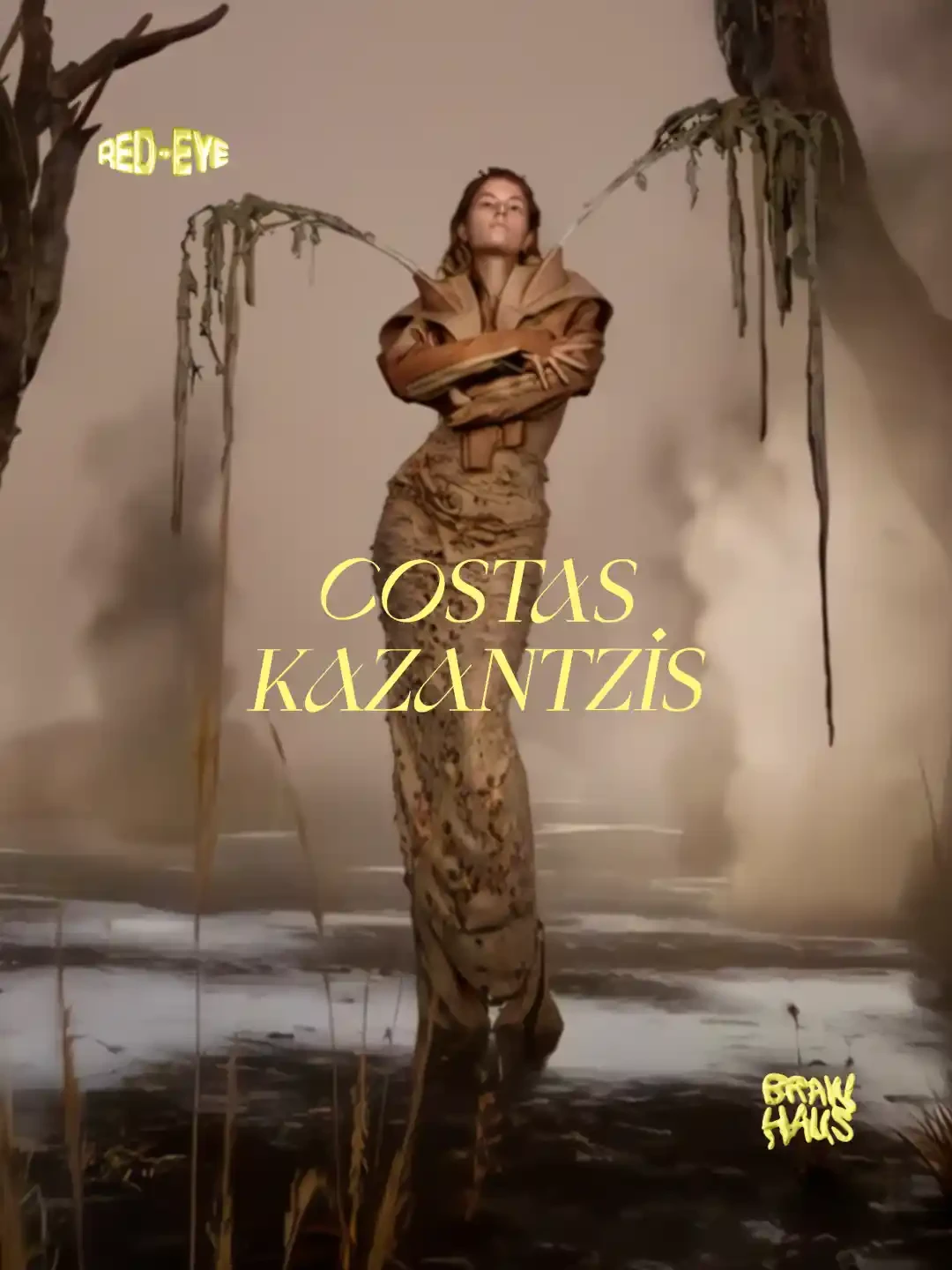
- Date
- 05 JANUARY 2026
- Author
- BRAW HAUS
- Image by
- COSTAS KAZANTZIS
- Categories
- Interviews
Costas Kazantzis on Immersive Fashion, XR, and the Future of Digital Storytelling
For its final co-joint feature, RED-EYE Magazine and Braw Haus turn their focus to the evolving terrain of immersive culture through the work of creative technologist Costas Kazantzis. Positioned at the intersection of game engine technology, 3D design, and extended reality, Kazantzis’ practice proposes a new relationship between digital systems and human experience, one where technology is not a substitute for the physical world but a mechanism for expanding it.
With a background that spans computer engineering, fashion media production, and visual communication, Kazantzis approaches immersive technologies as emotional, social, and political tools. His research interrogates how interconnected cyber-physical ecosystems shape identity, perception, and presence, while actively challenging the dominant structures of gaming culture that prioritise linear progression, finite outcomes, and instant gratification. At the core of this work lies a commitment to disrupting conventional mechanics in favour of slower, more fluid modes of interaction that create space for queer narratives, collective memory, and embodied storytelling.
Currently Lead Creative Technologist at the Fashion Innovation Agency at London College of Fashion, where he also lectures on immersive technologies and their applications within the creative industries, Kazantzis is simultaneously completing a PhD at UAL’s Creative Computing Institute. Across music videos, AR installations, digital exhibitions, and experimental pipelines such as Reskinning Reality, his work constructs living environments where fashion, art, performance, and computation converge.
In this conversation, Kazantzis reflects on his nonlinear journey into immersive practice, the politics of world-building, and the futures of fashion and storytelling in an increasingly hybrid reality.
Your background bridges computer engineering, fashion media, and XR technologies. How did this unexpected mix lead you to the work you do today at the intersection of art, tech, and fashion?
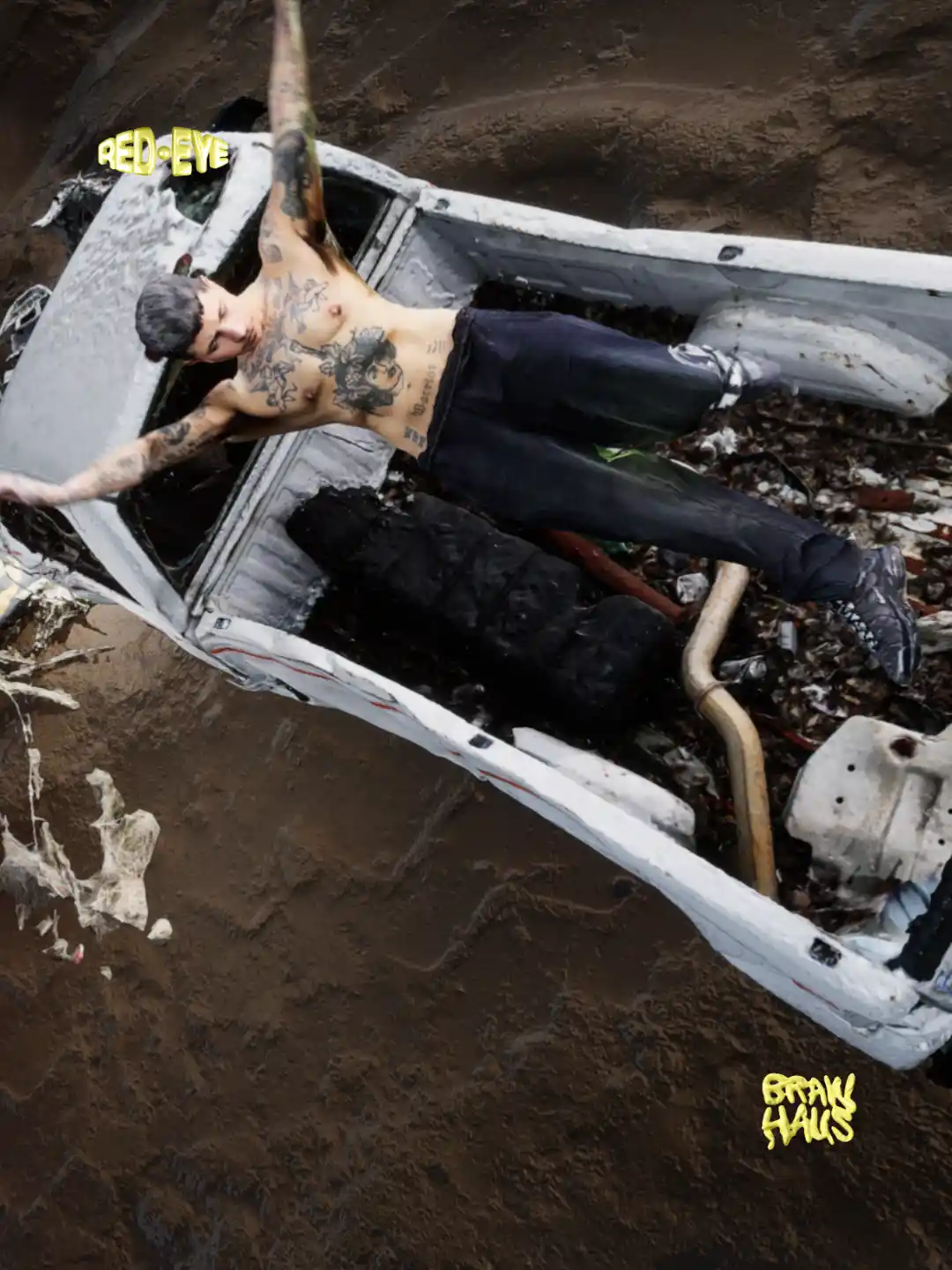
My path into immersive work was never linear, and I think that’s been the most important part of it. Computer engineering gave me a way of thinking in systems, how things connect and operate, but I was never satisfied with its obsession with efficiency. What interested me more was what happens when technology fails, and what this could signify for the discovery of new visual languages. By carrying that mindset into a more artistic space, I’ve been able to treat technology not just as a tool of productivity, but as something human, something we can experiment with, fail alongside, and ultimately create new visual vocabularies through.
During my studies, as I began to specialise in biomedical engineering, I became fascinated with how technology could extend visual perception. At the same time, I was pursuing a degree in photography, and the overlap between those worlds began to shape how I thought about image-making. I was working on cancer research at the time, using medical imaging of prostate cancer cells, and I started texturing 3D objects and building virtual landscapes with microscopic imagery. It was an intuitive process of taking something rooted in science and pushing it into an aesthetic context. It showed me how technology could move beyond efficiency into poetics.
That was the point when I turned to VFX and game engines, because they offered a way to step beyond the flat image and build immersive, three-dimensional environments filled with complexity, movement, and emotional texture. Fashion media then gave me another layer — an attention to materiality, styling, and the body — which continues to shape the language of my virtual worlds. XR became the bridge across all of this, because it collapses the distance between digital and physical: it lets me bring the virtual into the real world and experience the online in 360 degrees rather than being confined to a flat screen.
That unexpected mix — systems thinking, visual storytelling, and experimental XR — is what drives my practice today. My work lives in those moments when technology stops being just a tool and becomes a way to reimagine how we experience fashion, art, and identity.
In your own art-driven projects—music videos, AR installations, digital exhibitions—you build immersive experiences that center audience interaction. Could you walk us through a recent piece and the creative-to-technical arc behind it?
Collaboration is at the core of all my art-driven projects. For me, the most important part is working with people who inspire me and with whom I can build a safe space of sharing — a space where creative dialogue emerges naturally and where the work grows out of our needs and desires rather than a fixed plan. I’m less interested in finished objects than in processes that hold people, stories, and collective imagination. In that sense, the technology I use is never chosen only for its novelty. It’s always shaped through the project’s creative dialogue. I’m less interested in using a new tool for its own sake, and more in asking how, or if, a particular technology can enhance the storytelling mechanism we’re building, and what it means when it doesn’t. That tension is part of the work.
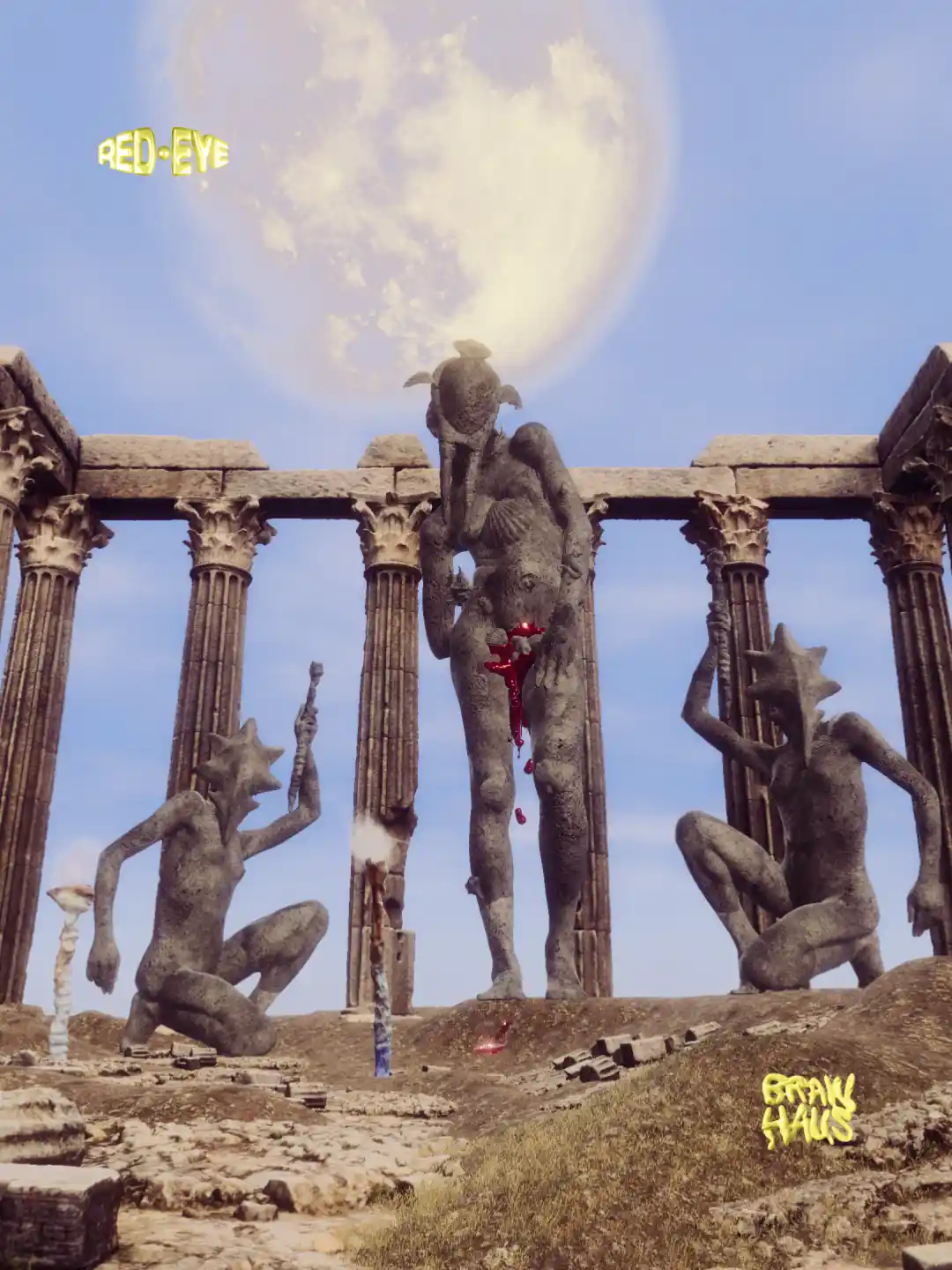
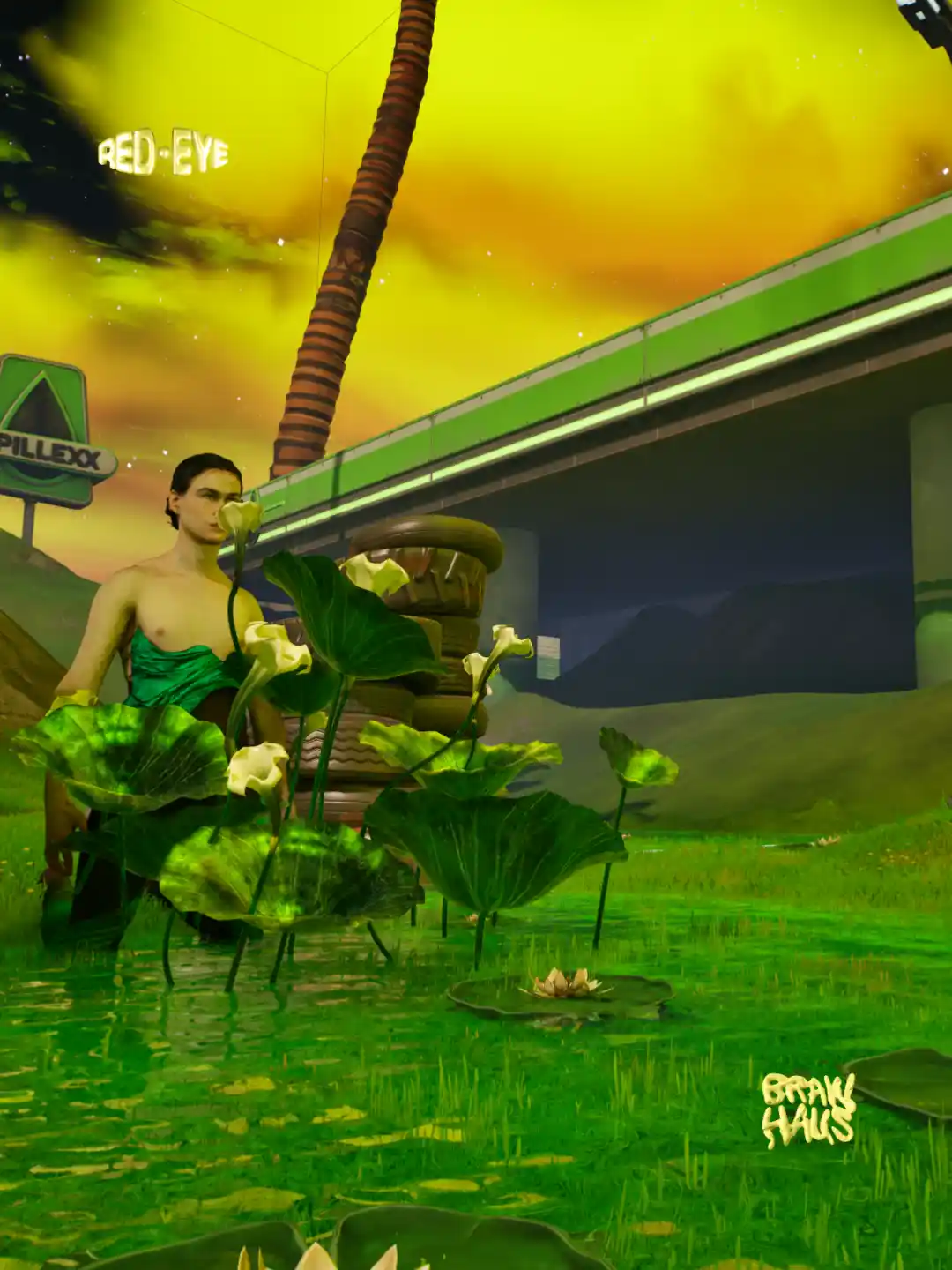
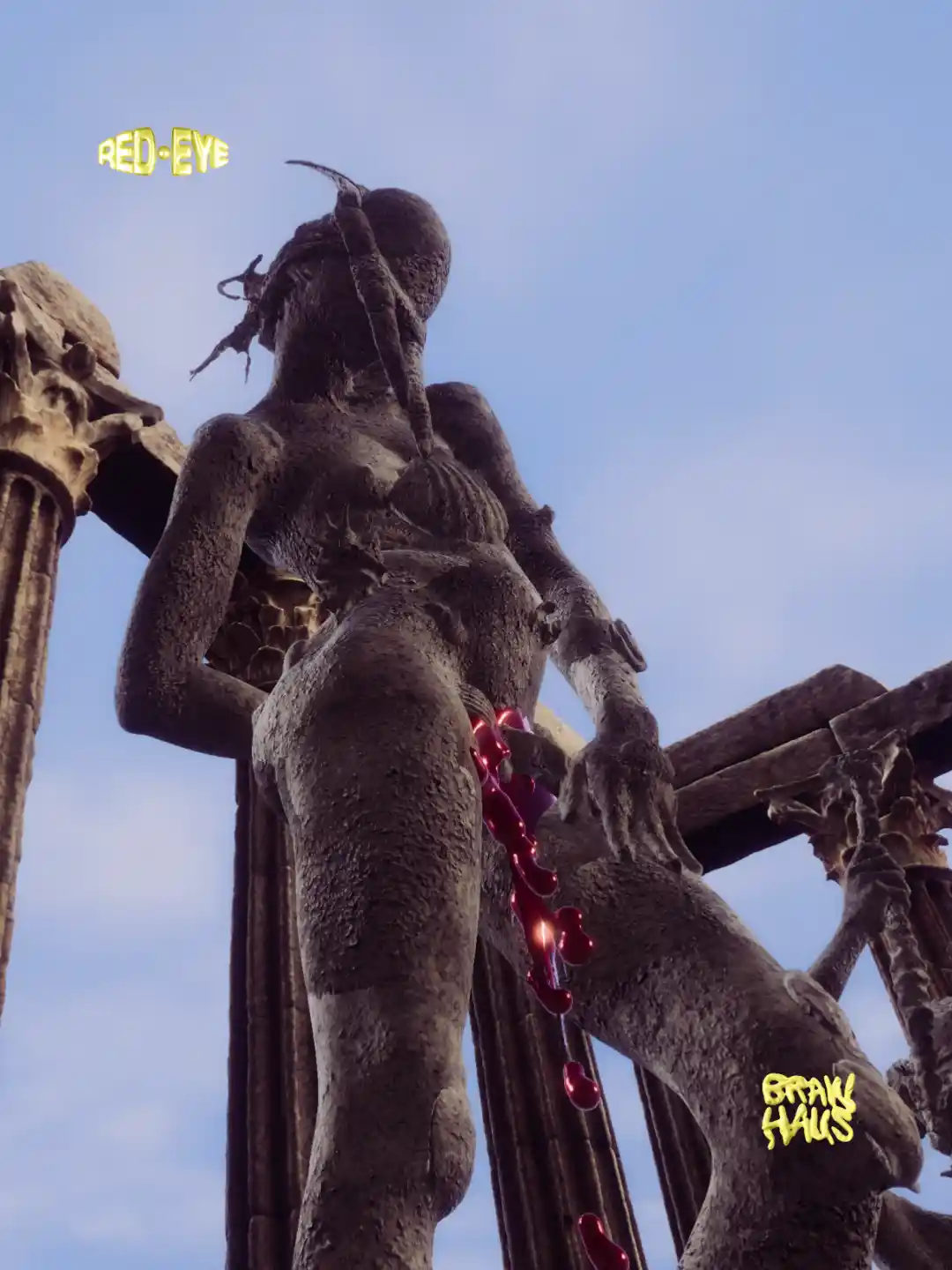
One project that captures this is Remnants of Self’s: Trans Temple, created in collaboration with the artist Anthr0morph. It’s an immersive digital art project that explores the fluidity of identity, gender, and transformation. We combined high-quality 3D scans, photogrammetry, and Unity Engine to construct a virtual temple — at once a sanctuary and a gallery — that holds past, present, and future embodiments of the self. The temple was less about presenting a static narrative and more about creating an environment where people could encounter themselves and each other differently.
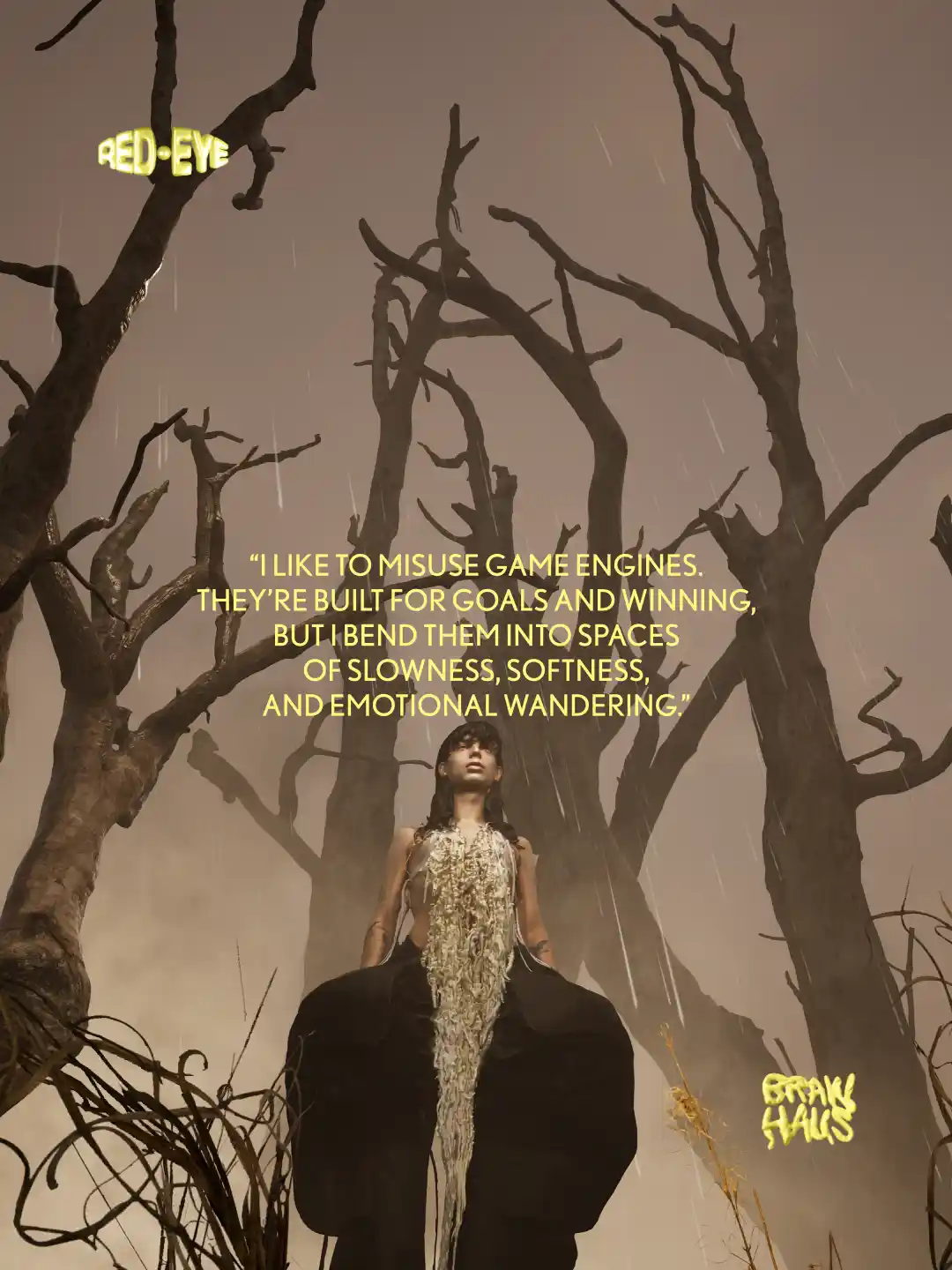
What excites me about working in game engines is that they were built for linear logics — goals, competition, winning, levelling up — but I like to misuse them. I push against those mechanics to create spaces of slowness, repetition, and emotional wandering. Instead of doing, the focus becomes on being. It’s not about success or failure, but about opening an intimate, uncertain, alive experience. I think of it in the same way that certain writers or poets disrupt grammar to open new emotional or political possibilities. By bending the rules of game design, I can shape worlds that carry care, fluidity, and queer modes of storytelling at their core.
Are you incorporating ai in your workflow? If yes how, in which step of your process and which programs do you use?
I often work between Unreal Engine and Unity because they allow me not just to design 3D environments, but also to shape how people interact with them — the logic, the pacing, the atmosphere. What excites me about these engines is that they combine visual design with programmable behaviours in one space, which makes them ideal for creating immersive and responsive experiences.
AI has increasingly become part of that process. For example, I’ve used AI models for contextual mapping to make XR environments more adaptive and responsive to users. In fashion work, one of the most complex challenges is simulating fabric in real time at a level that feels convincing and honours the materiality of fashion. Here, custom AI models for cloth simulation, alongside industry-standard tools such as in-engine cloth systems, have pushed the work further, making it possible to capture fluidity and tactility that wasn’t achievable before.
I also integrate motion capture into my workflow, and AI-driven approaches have helped make this more accessible. Instead of relying only on full suits and studio setups, I can now animate digital characters through everyday movement data, which expands how and where I can capture performance. For me, AI isn’t about replacing creative decision-making but about extending the expressive possibilities of the tools — it becomes another layer in the dialogue between technology, storytelling, and embodied experience.
What would be your dream project?
My dream projects are usually the ones that begin as experiments, where I don’t know if something will work or not, but I follow the curiosity anyway. For me, the process of testing, failing, and pushing tools beyond their intended use is what opens new creative possibilities. That’s exactly how Reskinning Reality started. What began as a small research experiment has now substantialised into a creative solution we can offer to brands and artists, and for me that journey is what makes it a dream project.
Reskinning Reality is an experimental pipeline that merges volumetric capture with digital garment simulation. By capturing a single live performance, the system allows hundreds of hyper-real digital garments to be reskinned onto the same moving model, complete with realistic physics and textures. It brings physicality into immaterial space with an unprecedented level of quality; the tactility, movement, and weight of fashion remain alive, even as the context shifts into a virtual environment.
What excites me most is how this technology can move across fields. Of course I’d love to work more with fashion brands, but I also see incredible potential in music, live entertainment, and performance. It’s not about using technology for its novelty, but about extending storytelling, creating stages, installations, and digital experiences where the body, its clothing, and its movement carry the same intensity in virtual space as they do in physical reality. That sense of experimentation, of not knowing but discovering along the way, is exactly what makes Reskinning Reality — and projects like it — a dream for me.
With whom would you like to collaborate and why?
In my personal practice, I’m exploring how game engines and interactive 3D platforms can be used to design virtual spaces that hold and share queer histories, particularly lived experiences and memories. I’m always drawn to collaborate with friends and other artists from the queer scene in London and internationally, continuing to explore how queerness can be more than character representation within virtual space. For me, it is also a design methodology and a way of world-building, a means to create platforms that feel more human, fluid, and less bound by heteronormative structures.
When it comes to collaboration within fashion, I’m especially drawn to brands and independent designers who see technology not as a surface effect but as a storytelling medium. I’m interested in people who are willing to take creative risks and allow their work to exist across both tangible and virtual realms. Being based in London is ideal for this, as the fashion scene here tends to be more experimental, open, and forward-thinking. It’s an environment that encourages collaboration across disciplines and invites new ways of imagining what fashion, art, and technology can become together.
Looking forward, what excites you about the next frontier in fashion-tech or immersive storytelling? Is there a dream medium, technology, or concept you’ve yet to explore?
Looking forward, what excites me most is the convergence of 3D and AI. I’m fascinated by how AI systems can recognise and respond to the physical world around us, creating digital environments that are not only immersive but also adaptive and intelligent. For me, this opens up a new frontier where tangible and immaterial realms can truly coexist, where the digital doesn’t replace the physical, but extends it in unexpected ways.
I’m particularly inspired by the possibilities this creates for fashion and immersive storytelling. At the moment, many projects require extensive post-processing to reach the level of quality and responsiveness we want. But with advances in AI and 3D integration, we’re moving towards a point where these experiences can happen in real time, without the long delays between creation and presentation. That shift feels transformative, because it means immersive fashion can be more immediate, more performative, and more alive.
This is the direction that inspires so much of my current work: exploring how these technologies can move us closer to responsive, living environments where fashion, art, and storytelling unfold dynamically, in dialogue with the people experiencing them.