- Date
- 30 MARCH 2026
- Author
- JAGRATI
- Image by
- JANG YEONJEONG
- Categories
- Interviews
Exploring the Digital Sublime: Jang Yeonjeong on Generative Art and Post Natural Landscapes
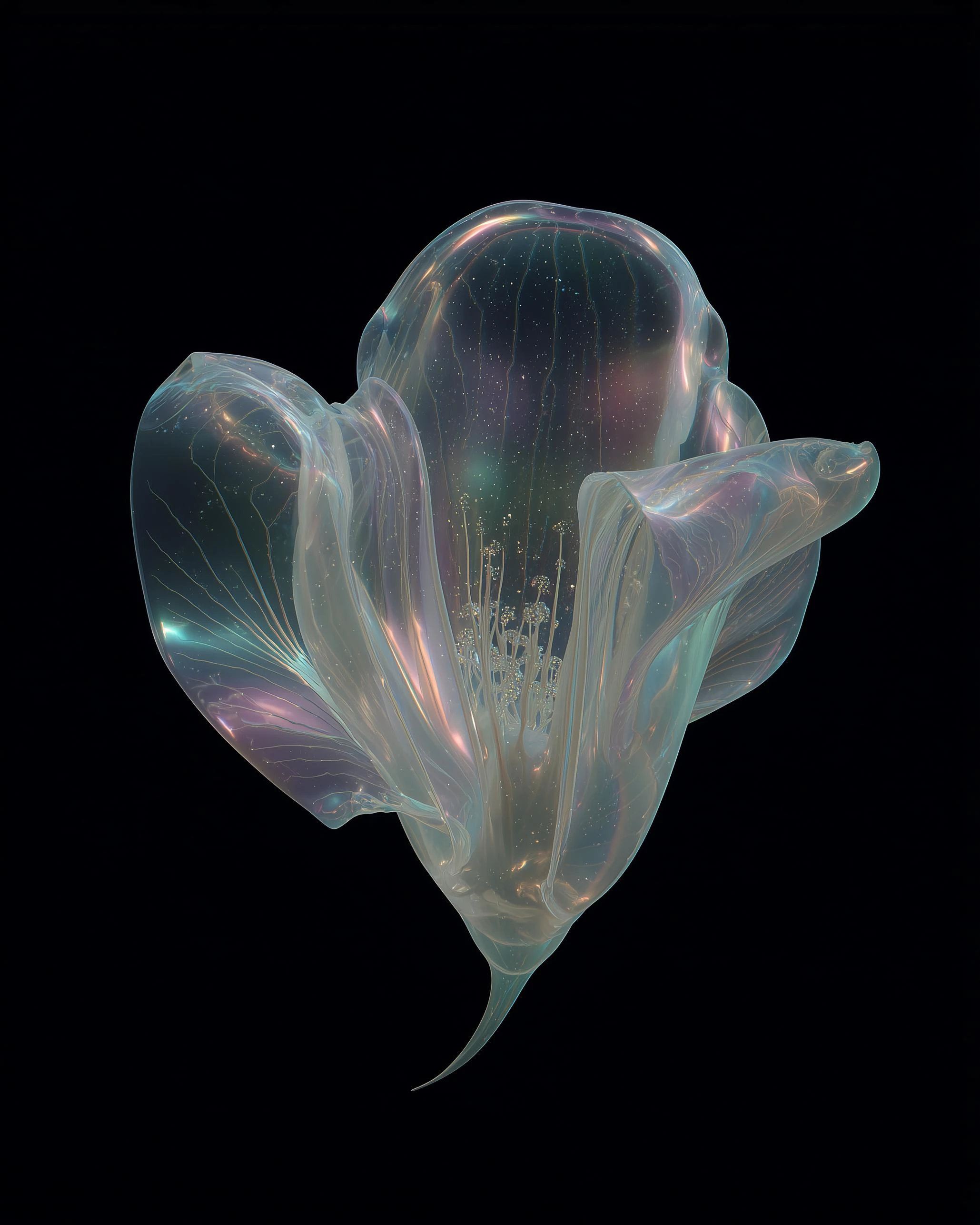
In a digital landscape saturated with hyperreal imagery and algorithmic aesthetics, Jang Yeonjeong, known as forside_art, constructs environments that resist immediacy and certainty. Her work occupies a liminal space between the organic and the synthetic, where landscapes are not depicted but reconfigured as perceptual fields. Drawing on her background in fine art and theoretical research, she explores what she defines as the digital sublime, a quiet yet destabilising condition where perception begins to slip and reform.
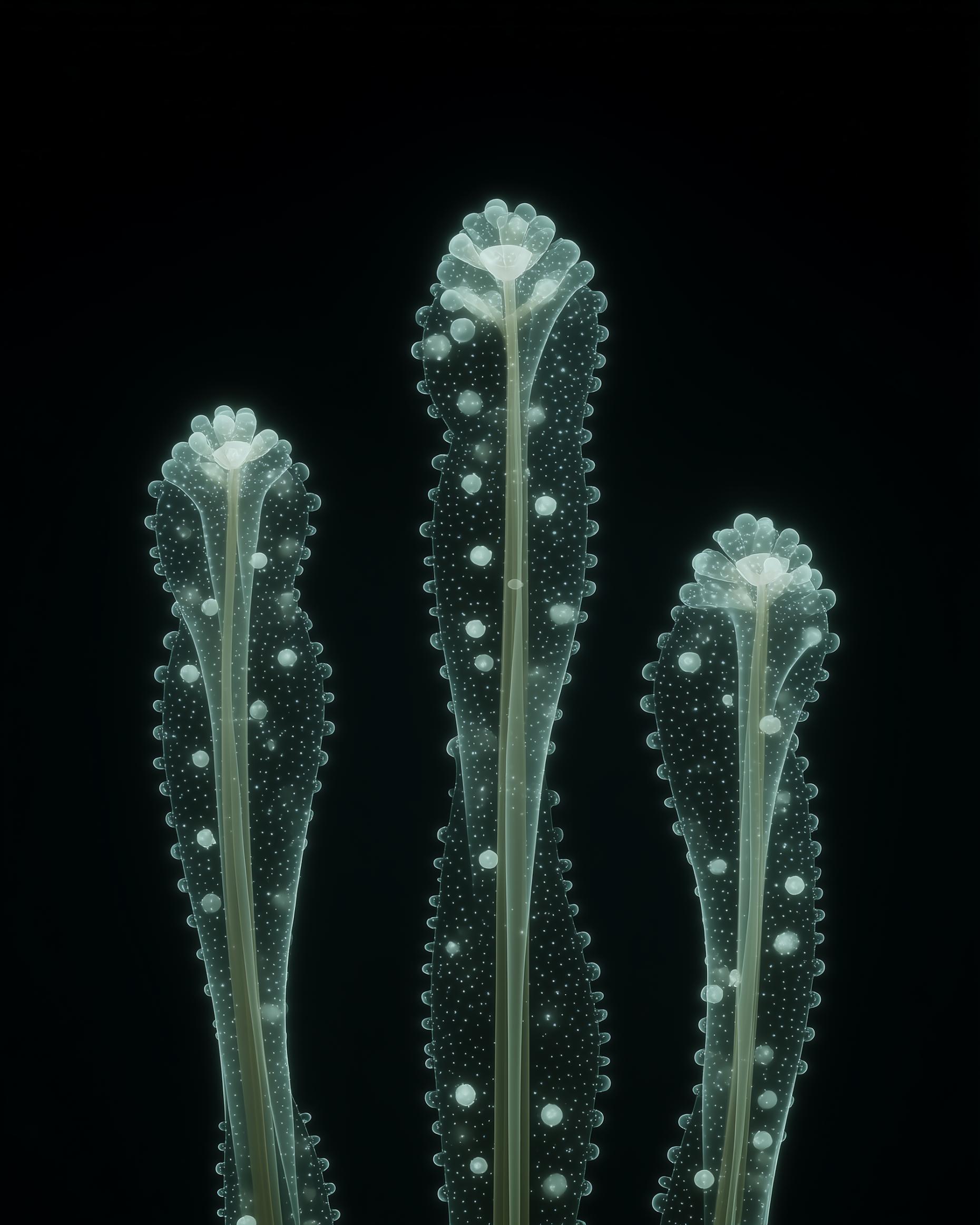
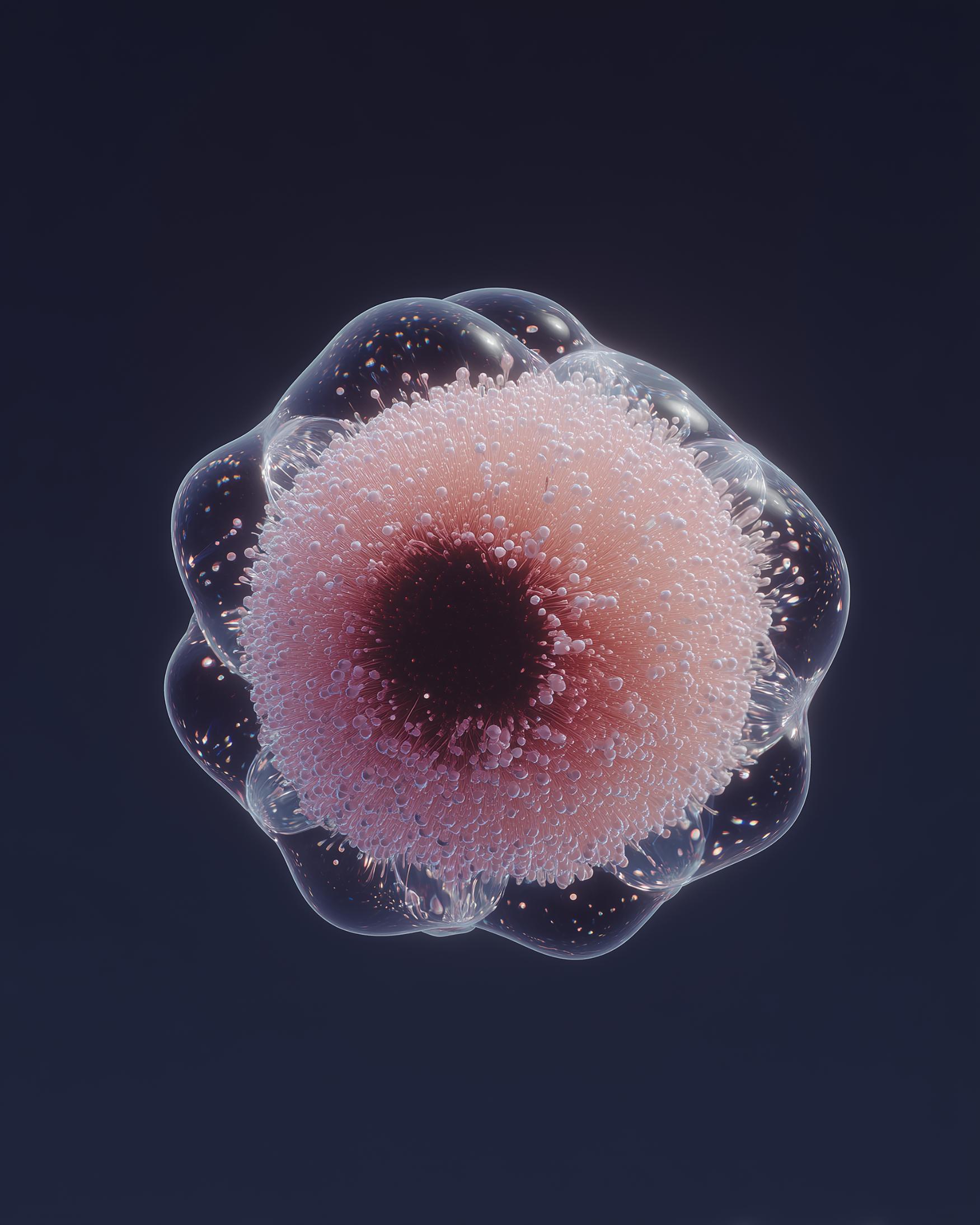
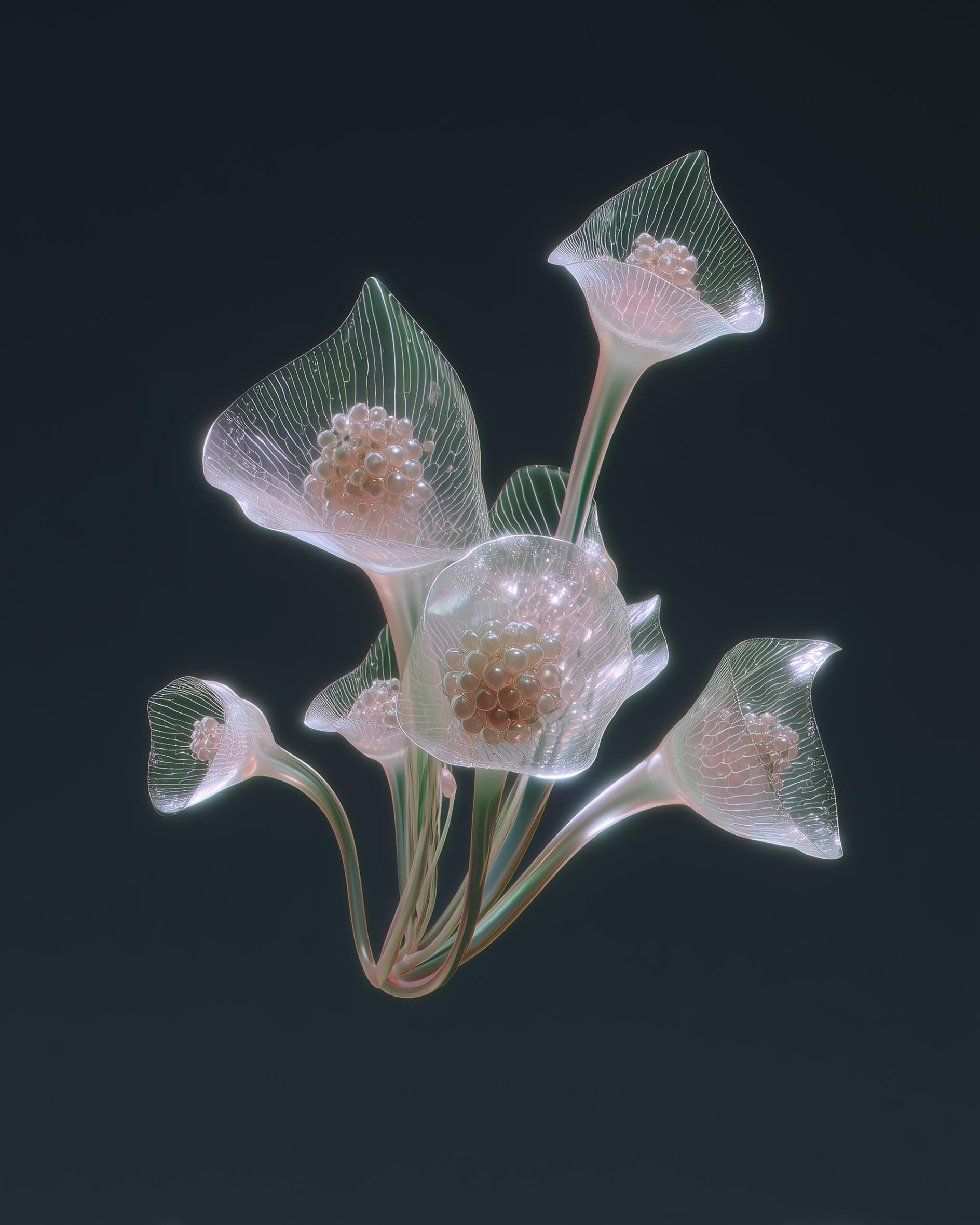
The artworks featured in this piece are drawn from her ongoing series Digital Sublime, where familiar forms dissolve into generative structures that feel both natural and artificial. Botanical elements flicker between recognition and abstraction, stripped of biological life and reconstituted through systems. What emerges is not a landscape in the traditional sense, but a post natural condition where memory, sensation, and structure converge.
At the centre of her practice lies a fundamental question. How do we perceive reality when experience is continuously shaped by digital systems, cultural frameworks, and invisible infrastructures. Her environments do not provide answers. Instead, they hold the viewer in a state of suspension, inviting a slower, more conscious awareness of perception itself.
In our exclusive interview, Jang Yeonjeong reflects on her shift from image making to system building, her exploration of generative technologies as a conceptual framework, and the evolving relationship between nature, perception, and existence. Read the full conversation to enter her mediated worlds and uncover the subtle conditions shaping how we see today.
Your practice constructs digital environments that feel at once organic and simulated. Could you reflect on your early background and formative experiences? What initially led you to this exploration of mediated landscapes and perception?
My practice did not originate from a specific medium or technology, but from a fundamental question about how we perceive the world. While studying design history and aesthetics, I became increasingly aware that what we consider reality is never encountered directly. It is always mediated and structured through systems, frameworks, and cultural modes of interpretation. Modern and contemporary design does not simply represent nature. It selects, arranges, and reconstructs it, producing a constructed field of perception. This led to a shift in my thinking. The world was no longer a fixed object to observe but something continuously formed through perception itself. From that point, my work moved away from depicting nature toward examining the structures through which perception is produced. The environments I construct are not representations of real landscapes but mediated perceptual fields where sensation, memory, and structure are intertwined. They may appear organic, yet they are generated through systems. They may feel like nature, yet they are stripped of biological life. This dual condition reflects how we experience the world today as something simultaneously real and constructed. My work is not about representing nature but about revealing the conditions of mediation and the moments where perception begins to shift.
What first drew you to digital and generative systems as your primary medium? Was there a defining moment when you recognised technology not just as a tool, but as a conceptual framework for your work?
Initially, I approached digital and generative systems as tools to construct forms and produce images with greater flexibility. As my practice evolved, I began to recognise a deeper layer within them. What is generated in a digital system is not simply a finished image but an event that emerges from a set of conditions and structures. Even with the same input, the result is never identical. Forms shift, deviate, and reconfigure in subtle ways. This led me to a critical question. Am I creating an image, or am I setting the conditions for something to emerge? That question marked a turning point. I no longer understood technology as a neutral tool but as a structure of thinking. Generative systems do not fix outcomes. They operate through continuous variation and open ended states. Within these states, forms and sensations remain unresolved. This directly resonated with my inquiry into the instability of perception. My work shifted from producing images to constructing systems in which perceptual shifts can emerge. Digital and generative systems became not just my medium but a conceptual framework through which perception and existence are reconfigured.
Much of your work imagines a post natural condition. What motivated this shift away from traditional representations of nature, and what does it reveal about our contemporary ecological consciousness?
For me, nature is no longer something that exists as an autonomous entity but something we encounter through layers of mediation. We believe we experience nature directly, yet what we perceive is already filtered through images, data, interfaces, and cultural frameworks.This realisation led me away from traditional representations. Instead of depicting nature itself, I became interested in how it continues to exist as a residual structure. In my work, nature no longer grows or cycles. It appears compressed, suspended, and stripped of function. What remains is form, and even that form begins to resemble a structure rather than a living organism. This is what I refer to as a post natural condition. It suggests not only that nature has changed, but that our relationship to it has fundamentally shifted.We are not distant from nature. We are so entangled with it that we can no longer perceive it as independent or unmediated. My work does not attempt to restore nature but to acknowledge its transformation and make that altered condition perceptible.
The notion of the sublime in your work feels understated. How do you reinterpret the sublime within a digital context, and what kind of perceptual or psychological state are you seeking to evoke?
For me, the sublime no longer emerges from spectacle or overwhelming scale. It arises in a quieter condition, when perception itself ceases to operate with certainty.Traditionally, the sublime was understood as an encounter with vastness that revealed the limits of human comprehension. Today, we encounter those limits within mediated environments. This is where I locate the digital sublime.It is not a rupture but a sustained condition. Forms are present but not fully defined. Structures appear yet resist stable interpretation. Sensations are felt but remain unresolved.Within this state, the viewer oscillates between cognition and sensation. I think of it as a moment when internal perception begins to shift. My work avoids spectacle and instead holds the viewer in suspension. It invites them to linger and become aware of perception itself unfolding.
There is a persistent tension in your work between the natural and the artificial, memory and simulation, presence and absence. Do you see your practice as speculative, archival, or elegiac?
I see my practice as operating across all of these conditions at once. It is speculative, archival, and in a certain sense elegiac. In its speculative dimension, the work does not predict the future but makes visible structures of change that are already unfolding. It imagines how nature and existence might persist as transformed conditions.At the same time, it carries an archival quality. It does not document nature in its vitality but records what remains after transformation. For this reason, the images often feel like traces rather than moments. This is where the work becomes elegiac. It is not about mourning a clearly defined loss but about sensing that something has changed without being able to fully articulate what. Nature persists, but in a different form, and we find ourselves within that transformation.The work does not attempt to restore what was. It attends to what remains.
Your work engages deeply with perception. How do you understand the role of the viewer within these environments?
I do not define the viewer strictly as an observer or participant. I see them as something in between, a condition through which perception is formed. The work does not deliver fixed meaning or guide interpretation. Instead, it creates an environment where perception itself becomes visible. The viewer attempts to recognise forms but cannot fully define them. They try to interpret structures, but meaning remains unstable. In that moment, the viewer is no longer outside the work but becomes part of the perceptual field. I think of this as inhabiting perception. The viewer is neither passive nor active but a presence that co constitutes the experience. The work itself becomes operative only through this encounter.
As digital technologies reshape how we experience reality, what role should art play within this transformation?
Digital technology does not simply introduce new tools. It reshapes how we experience reality itself. Reality is no longer fixed but continuously generated and reconfigured.In this context, the role of art is not to explain but to reveal the conditions through which we perceive the world. Digital art is uniquely positioned to engage with these mediated structures.Rather than addressing ecology or existence as themes, it allows us to experience how our relationship to nature has already been transformed. It is not about delivering a message but about shifting perception.My work constructs situations where viewers become aware of their own sensing. The speculation is not about the future but about the present condition we are already inhabiting.We are living in a post natural state. My intention is to make that condition perceptible.
Looking toward the future, what directions or questions feel most urgent in your practice?
What feels most urgent is not the production of new images but a deeper inquiry into how perception is changing. My work has focused on how nature persists as structure and on moments where perception becomes unstable.Moving forward, I am interested in how these structures unfold over time. How they transform, endure, or dissolve. I am drawn to states that resist fixation, forms that have not fully emerged or continue to shift after appearing complete.Because of this, my practice is expanding beyond still images toward time based and spatial environments. I am interested in constructing immersive conditions that involve movement, space, and the viewer’s experience.Technology remains a condition rather than a goal. What matters is how it reshapes perception.The core question remains the same. What kind of world are we experiencing now, and how are our senses evolving within it.