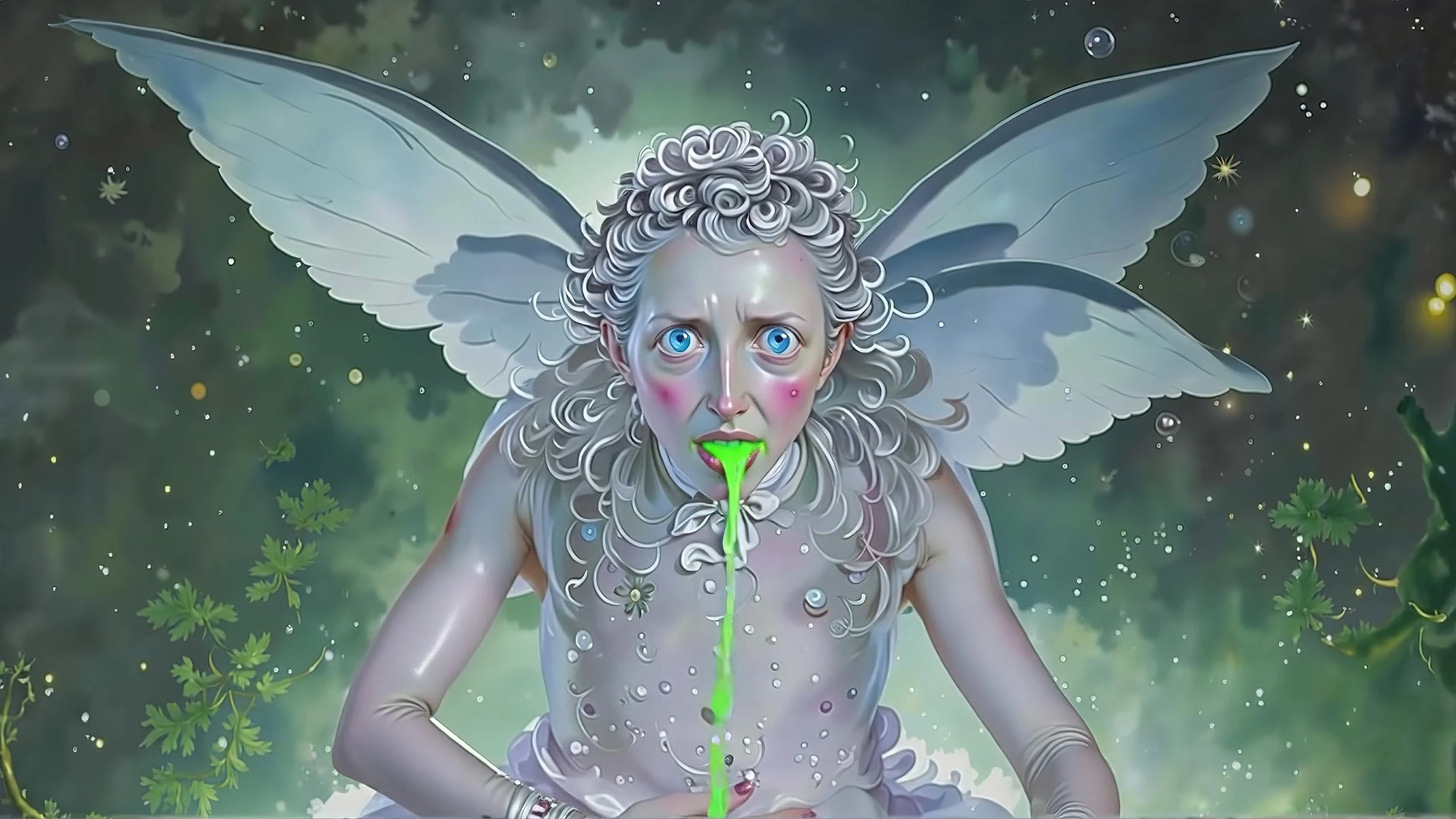
- Date
- 01 OCTOBER 2026
- Author
- DANIEL FACE
- Image by
- RACHEL MACLEAN
- Categories
- Interviews
Rachel Maclean on AI, Scottish Folklore and the Strange Future of Image-Making
For Rachel Maclean, the boundary between technology, folklore and fantasy has never been particularly fixed. The Scottish artist, whose practice moves between film, painting, digital imagery and performance, has long used invented worlds to examine identity, desire and the systems that shape how we see ourselves. At Sonica Glasgow, Maclean presented They’ve Got Your Eyes, a film that brings these concerns directly into conversation with the rapidly evolving possibilities of artificial intelligence.
The film takes its title from the familiar phrase used to describe a child’s resemblance to a parent, but Maclean turns the expression into something more unsettling. Having trained an AI model on her own work and image, she explores what happens when an algorithm begins reproducing her likeness without requiring her physical presence. The result is a strange meditation on authorship, reproduction and the increasingly blurred relationship between artist and machine.
Scottish folklore becomes another lens through which Maclean approaches AI. Her fairies are not simply magical creatures but figures for an intelligence that feels simultaneously fascinating, unpredictable and impossible to fully comprehend. Drawing on Celtic folklore, Victorian scientific discovery and the Industrial Revolution, the film connects Glasgow’s architectural history with the technological transformation happening around us now.
At the centre of the film is an uneasy question: what happens when we create technologies whose capabilities extend beyond our own understanding?
Speaking to RED-EYE at Sonica Glasgow, Maclean discusses fairies, AI bias, Victorian technology, digital excess, Scottish folklore and the strange feeling of watching images being “vomited” into existence.
You’ve lived in Glasgow for around 15 years. What does it mean to return to the city as one of the main artists at Sonica?
It’s very cool. It’s such a great festival, and I love it for the fact that it spans music and virtual art and the interaction between these different genres.
Your background is in painting, but you became interested in moving image quite early on. How did that transition happen?
Before going to art college I was really obsessed with filming stuff. I had a little DV cam when I was about 12 or 13 and just filmed everything. Then I went and did high school art and a bit more painting, but when I was at art college I came back to moving image and discovered green screen.
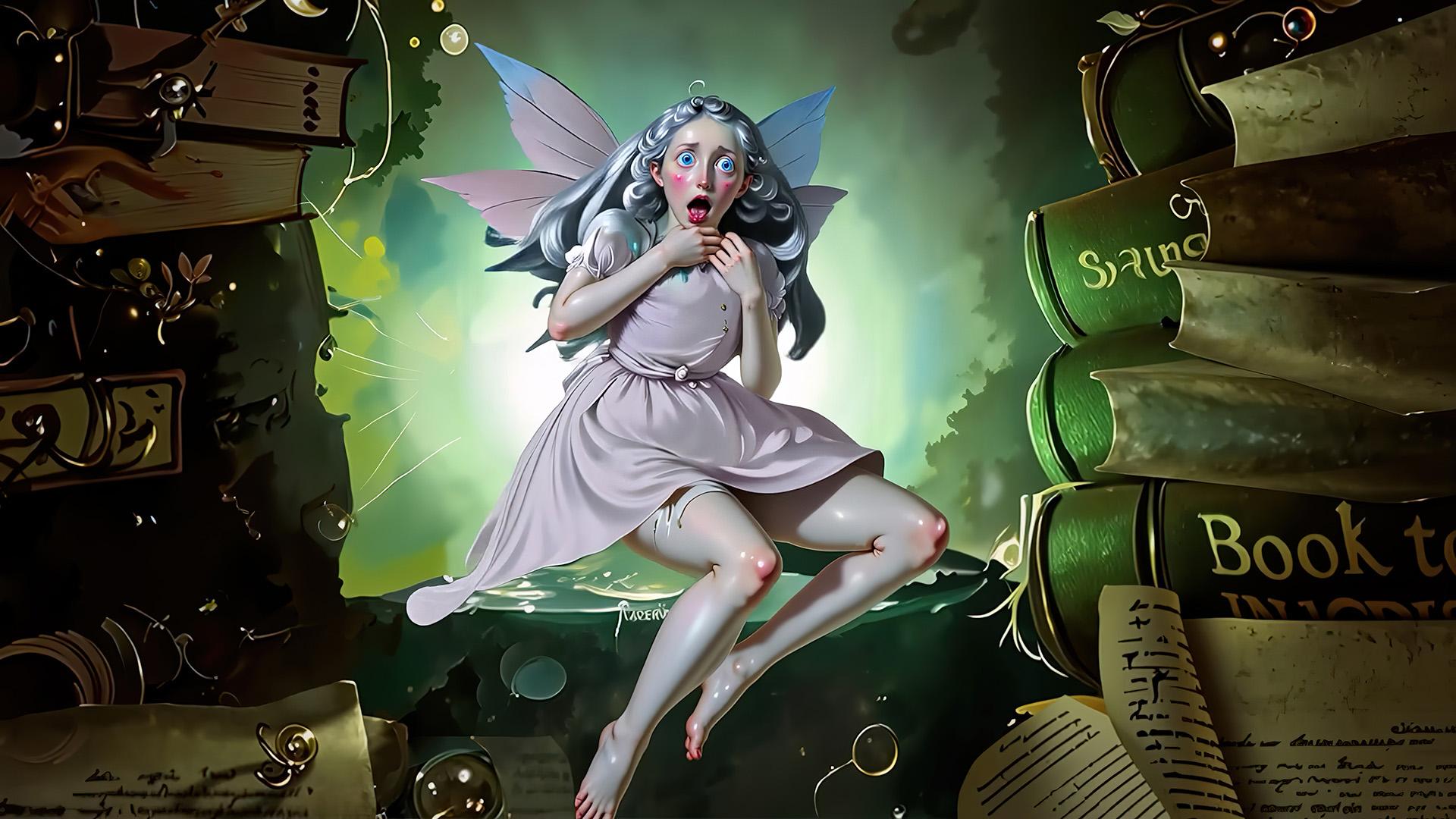
Scottish folklore is a huge part of They’ve Got Your Eyes. What attracted you to fairies, and how did they become connected to AI?
I got into the idea of fairies from thinking about the invention of powerful microscopes in the Victorian era. People didn’t previously know, for example, that they were able to see things in a glass of water. But the minute you’ve got these microscopes, you realise that there are living things in materials that you weren’t aware of.
That contributed to this renewed belief in fairies. You can’t quite see the edges of the discovery you’ve made, therefore these things that we thought were untrue could be true. I feel, to a certain extent, this is the moment we’re living through with AI technology. It’s cracked open a sense of possibility, but we don’t know quite what the edges of that are.
The title They’ve Got Your Eyes feels particularly relevant to your use of AI. Where did it come from?
I was quite interested in AI models and bias and the fact that they’re effectively biased to the training data. So I trained an AI model on my work and also my image. Whatever you run into this model, it will try and force my face onto it.
There’s something a little bit queasy and unsettling in that. The film has this bias towards reproducing me and reproducing my eyes. I wanted to relate it to reproduction and birth, in the sense of complimenting a parent on their likeness to a child by saying, “They’ve got your eyes.”
But unlike taking a photograph or video of yourself, which I’ve done in the past, the AI kind of does have my eyes and it’s almost running away with them to an extent, because it’s possible to produce this imagery without me needing to be there at all.
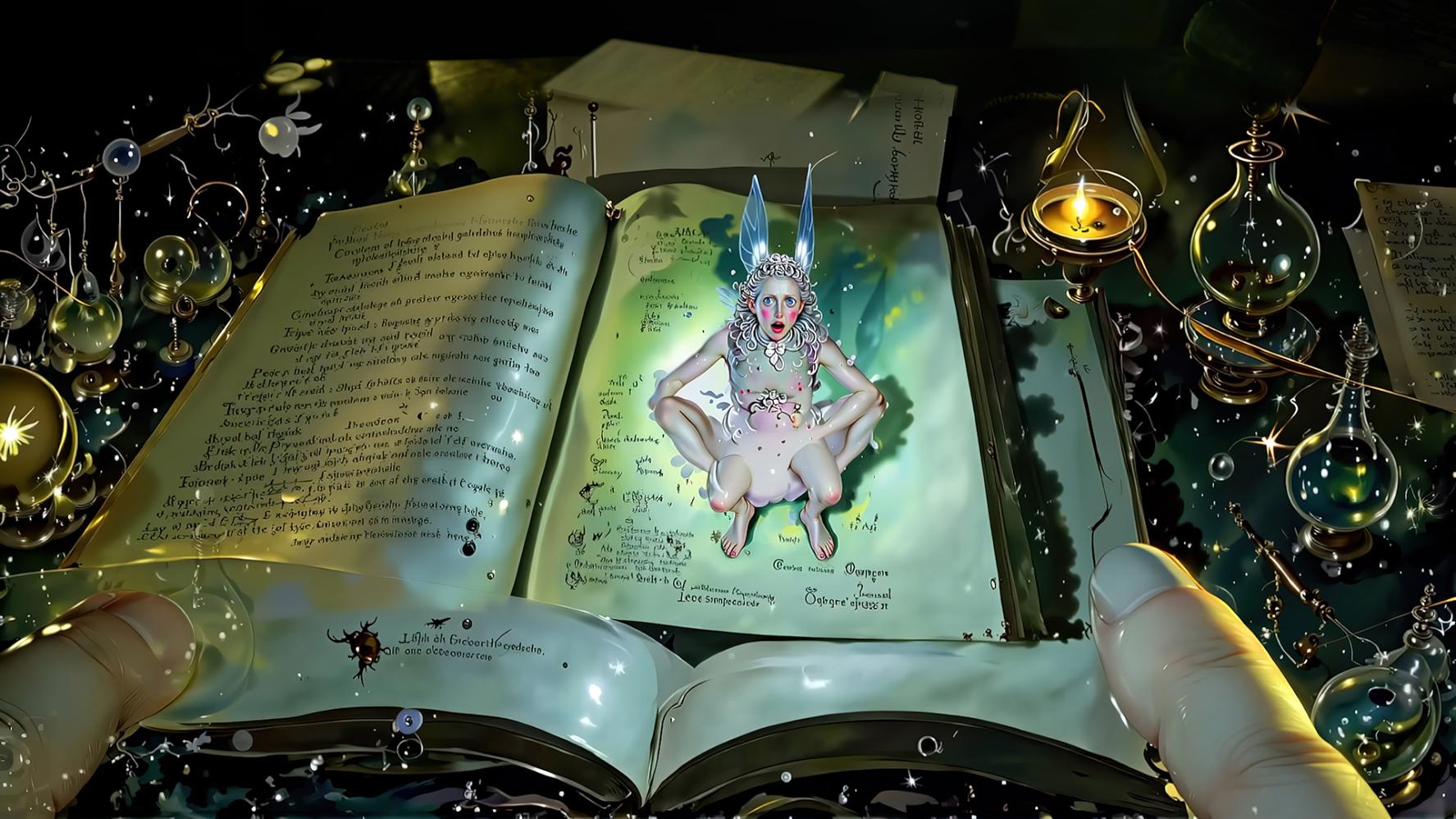
There’s also this Victorian-looking male character who feels like a caricature of a certain kind of technological power. Who is he?
I wanted him to seem a little bit like maybe a Victorian gentleman or somewhere between that and a Scottish Enlightenment figure. I was interested in thinking about the relationship between some of the tech bros today and maybe some of the merchants of the Victorian era.
Quite a lot of technological development comes from the egos, largely speaking, of men who are driving a lot of these changes. I wanted to represent this man with quite a fragile ego. You see him in quite base situations where he’s motivated by jealousy or motivated by the sense of seeing this other man who’s better than him at a thing that he wants.
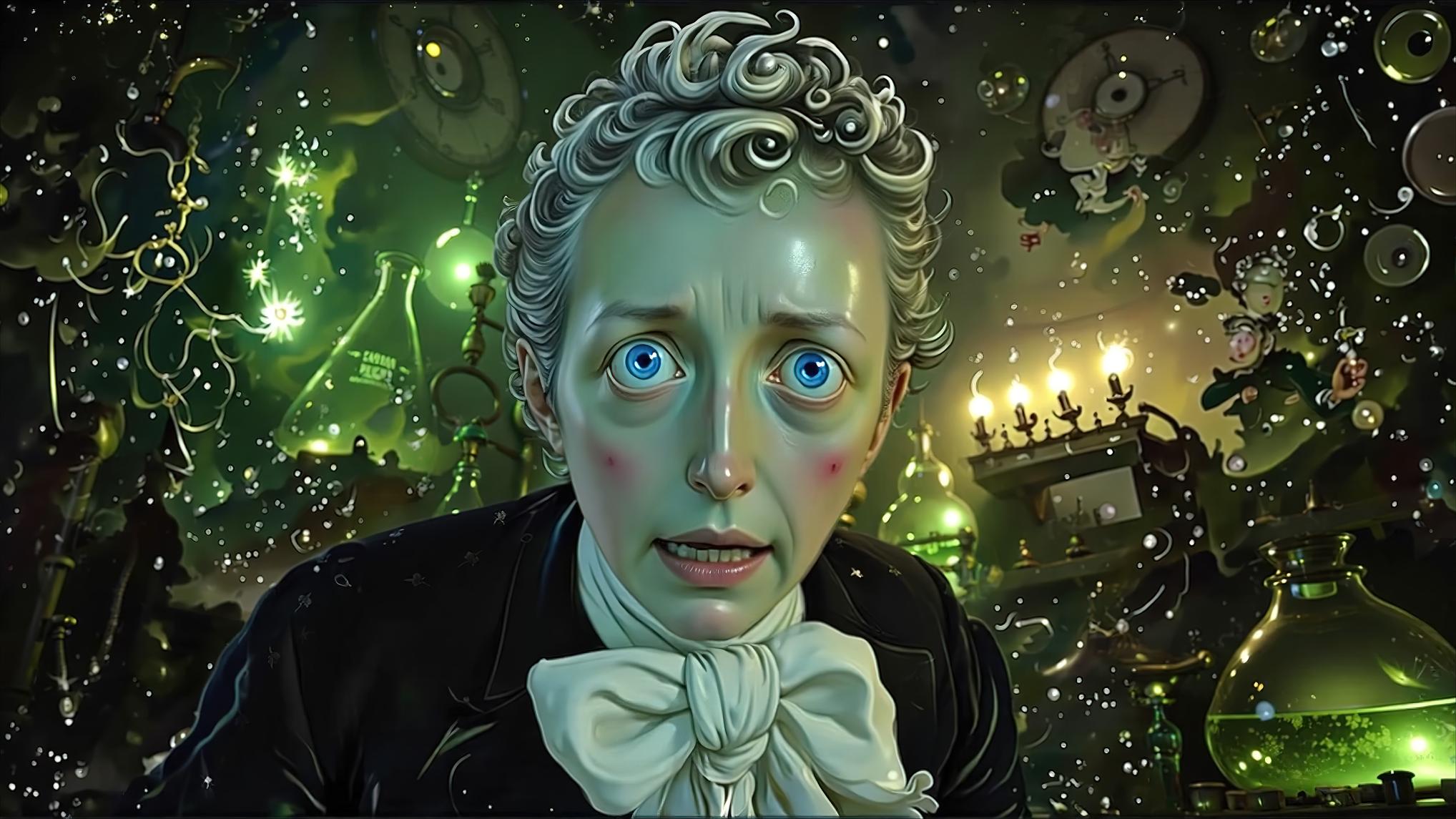
And what do the fairies represent?
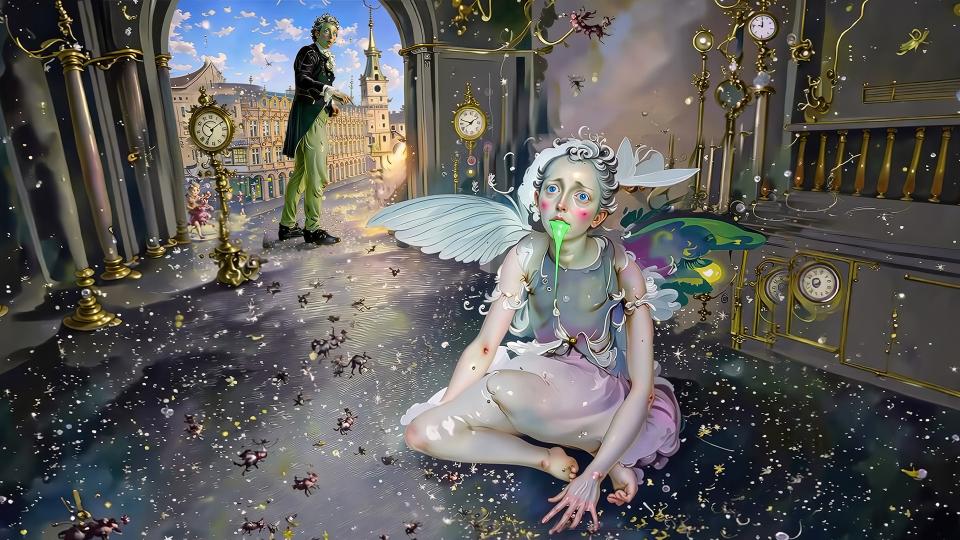
In a really basic way, they’re like a metaphor for AI technology. I wanted them to feel like a stand-in. There are references to the Pygmalion story but also to Frankenstein. You see him birth the fairy and then it is his creation. The fairy looks a bit like him but also looks a bit like me, and there’s this sense of reproduction.
Glasgow itself feels almost like a character in the film. Why was the city important to you?
I was going for this reference to the Industrial Revolution and the Victorian era, and I think Glasgow is an interesting city because so much of what Glasgow is was born very, very quickly, built very quickly at that time.
The architecture that we live in, and in loads of cases is kind of decaying around you as you walk around the city, is from that era. I wanted to take some of that, literally some of that architecture, and bring it into AI.
You described the green liquid in the film as AI “vomiting” images into existence. What does that idea represent for you?
It literally is like green vomit. You see the fairy as this metaphor for AI who’s just vomiting up these objects and often vomiting up a distorted version of what the gentleman has asked her to make.
It came a little bit from the idea of AI slop, but also from the experience of working with generative AI. I’ve made images for years using digital technology and it’s very, very slow and laborious. Then suddenly you’ve got this technology where it goes so fast, pumping out image after image after image.
There’s something that feels compulsive but also oddly wasteful about it. There’s just this plot of images appearing before you. I wanted to evoke some of that feeling of this technology almost vomiting things into being, and you can’t stop it.
Finally, Scottish fairies aren’t necessarily good or evil. They can be unpredictable, even dangerous. Is that ambiguity important to how you think about AI?
I think I thought a fairy was an interesting figure to pick because traditionally in Celtic folklore they’re neither good nor bad. They’re quite capricious characters.
I think that’s in some ways what AI technology is. It’s like an intelligence that we can’t understand. At some level it’s vastly more intelligent than humans because it is able to see and reproduce images in a way a human never could, but it does so without any embodied understanding of what the images represent.
There’s something about that perspective on the world that a human will never be able to have that I find quite fascinating. You’re able to connect with a way of thinking that is totally unknown.